Industry Insights by The Experts
Industry Intelligence from the Disruptors Redefining Private Label Manufacturing
Clinical Dose vs. Manufacturable Dose: Why Some Formulas Do Not Fit in a Capsule
Industry: Creators, Scaling Operators, Multi-Location, Medical Groups
Why Clinically Studied Doses Do Not Always Fit in a Capsule
When developing a supplement, brands often begin by identifying ingredients with published research behind them and selecting dosages that align with their product’s intended benefits. On paper, the formula may appear well supported. But once those ingredients are combined, the brand may discover that the finished formula cannot fit into the one- or two-capsule serving originally planned.
Consider a sleep supplement formulated with magnesium, L-theanine, and several botanical extracts. Each ingredient may have a specific purpose, with dosages selected based on relevant research and formulation goals. Individually, those amounts may seem reasonable. Together, however, they can create a substantial volume of material that exceeds the available space inside the intended capsules.
Clinical research can help inform ingredient selection and dosage, but it does not establish whether those ingredients can be combined into a practical capsule-based product. Published studies examine particular ingredients, preparations, and dosages under defined conditions. A finished supplement must also account for the physical properties of those ingredients, the space they occupy, and whether the complete formula can be manufactured consistently.
For supplement brands, this creates an important decision early in product development. Maintaining the intended dosages may require additional capsules per serving, a different delivery format, or adjustments to the formulation. Each option can affect the finished product and how customers use it.
Why Capsule Capacity Depends on More Than Milligrams
Adding up ingredient weights doesn’t necessarily tell you whether a formula will fit inside a capsule. A formula containing 800 mg of active ingredients might fit comfortably into a particular capsule size, while another formula with the same total weight could require significantly more space.
The difference comes down to bulk density, which describes how much a powder weighs relative to the volume it occupies. Some ingredients are relatively dense and compact, while others are light and fluffy, affecting how much material a capsule can hold.
This becomes particularly relevant when combining botanical extracts, amino acids, minerals, and other supplement ingredients with different physical characteristics. Capsules have fixed internal volumes based on their size, with common options including sizes 0, 00, and 000. However, there is no universal milligram capacity for any capsule size. The amount that fits depends on the density and characteristics of the finished powder blend.
For example, a brand may plan to deliver 1,000 mg of active ingredients across two capsules. If the combined powder is sufficiently dense, that serving size may be achievable. If the blend has a lower bulk density, the same 1,000 mg could require larger capsules or additional capsules per serving.
The Manufacturing Requirements That Affect Capsule Fill
Even when a formula appears to fit within the available capsule volume, manufacturers must determine whether the ingredients can be filled accurately and consistently during production. A powder blend that works in a small laboratory trial may behave differently when processed through commercial capsule-filling equipment.
One important factor is powder flowability, or how easily a material moves through manufacturing equipment. Some powders flow freely, while others tend to clump, stick to equipment, or move unevenly. Poor powder flow can lead to inconsistent capsule fill weights, particularly when a formula contains ingredients with different physical properties.
Manufacturers also need to consider blend uniformity. In a multi-ingredient supplement, the ingredients must remain adequately distributed throughout the blend so that each serving contains the intended amounts. Differences in particle size, density, and other powder characteristics can increase the risk of ingredient separation during handling and production.
Depending on the formulation, manufacturers may need to incorporate excipients or processing aids to improve powder flow, reduce sticking, or support consistent capsule filling. Although these materials serve a manufacturing purpose rather than providing the product’s primary benefits, they occupy space inside the capsule alongside the active ingredients.
For a formula already approaching its capsule capacity, even a relatively small amount of additional material can create a challenge. Manufacturers may need to evaluate different ingredient specifications, adjust processing methods, or reconsider the intended capsule size and serving count to achieve reliable production.
These challenges can become more significant during commercial production, when equipment must fill thousands of capsules consistently. A formula that requires frequent equipment adjustments, produces inconsistent fill weights, or struggles to maintain blend uniformity may need further development before it is ready for manufacturing.

What Happens When a Formula Exceeds Capsule Capacity
When a supplement formula exceeds the available capsule capacity, manufacturers and brands must evaluate which adjustments can preserve the product’s intended benefits while making it practical to produce. The right solution depends on the ingredients involved, their required dosages, and how the finished product is intended to be used.
One of the most straightforward options is to increase the number of capsules per serving. A formula originally designed for two capsules may require three or four to accommodate the intended ingredient amounts. This allows the brand to maintain its formulation without necessarily reducing dosages, although it changes the product’s serving size and daily usage requirements.
Increasing capsule size may also be an option. Larger capsules provide additional volume, but there are practical limits to how large a capsule can be before it becomes uncomfortable for some consumers to swallow.
In some cases, the manufacturer can evaluate alternative ingredient forms or specifications. Different grades of the same ingredient may have different bulk densities or processing characteristics, potentially improving how efficiently the formula fits into a capsule. However, substitutions must be evaluated carefully. Changes in ingredient form, concentration, or standardization can affect the amount required to deliver the intended active compounds and may influence how the formula aligns with supporting research.
Brands may also need to reconsider the ingredient combination itself. Removing a secondary ingredient or adjusting a dosage can create additional space, but those decisions should be guided by the product’s intended purpose and available evidence. Reducing ingredient amounts simply to meet a preferred capsule count can undermine the rationale behind the original formulation.
For formulas requiring substantial ingredient quantities, another delivery format may offer greater flexibility. Powders, for example, can accommodate larger serving weights without the same capsule-volume constraints. However, changing formats introduces other considerations, including taste, mixability, packaging, and how customers incorporate the product into their daily routines.
How Capsule Count Affects Product Cost and Customer Experience
Increasing the number of capsules per serving may solve a formulation challenge, but it can also change the economics of the product. A supplement designed for two capsules per day requires 60 capsules for a 30-day supply. Increasing that serving to four capsules doubles the bottle count to 120, potentially affecting ingredient costs, encapsulation, packaging, and shipping.
These changes can also influence how a brand prices and positions its product. A larger bottle or higher capsule count may increase production costs, while customers may compare the product’s price against competing supplements without fully understanding the differences in ingredient dosages. Brands must consider whether the additional ingredients and their intended benefits provide enough value to justify the higher cost and serving size.
Convenience is another important consideration. According to FMCG Gurus, 45% of global nutritional supplement consumers use only one supplement, highlighting the opportunity for products that address multiple needs within a single formula. However, combining more ingredients at meaningful dosages can increase the number of capsules required per serving.
A higher capsule count may be acceptable to customers who value a comprehensive formula and understand why the product requires multiple capsules. For customers seeking a simple daily supplement, however, taking four capsules instead of one or two may reduce the product’s appeal.
This creates a positioning decision for brands. The formula needs to deliver enough perceived value to justify its serving size, particularly when competing products offer fewer capsules per day. Brands should evaluate capsule count alongside ingredient benefits, pricing, and the expectations of their target audience.
Why Manufacturing Feasibility Should Be Evaluated Before Finalizing a Formula
Capsule feasibility should be evaluated while a supplement formula is still being developed, before brands commit to a specific serving size, packaging configuration, or production schedule. At this stage, there is greater flexibility to test ingredient specifications, assess how the finished blend performs, and identify potential manufacturing constraints.
Manufacturers can evaluate whether the proposed formula can be encapsulated consistently and determine which adjustments may be necessary. These findings give brands an opportunity to compare serving sizes, ingredient specifications, and alternative formats while considering their impact on product cost and customer experience.
"One of the biggest mistakes brands make is finalizing a formula before understanding how it will perform in production. Those early decisions can affect everything from manufacturing consistency to product cost and the customer experience."
Steven Anderson, CEO Next Day Nutra
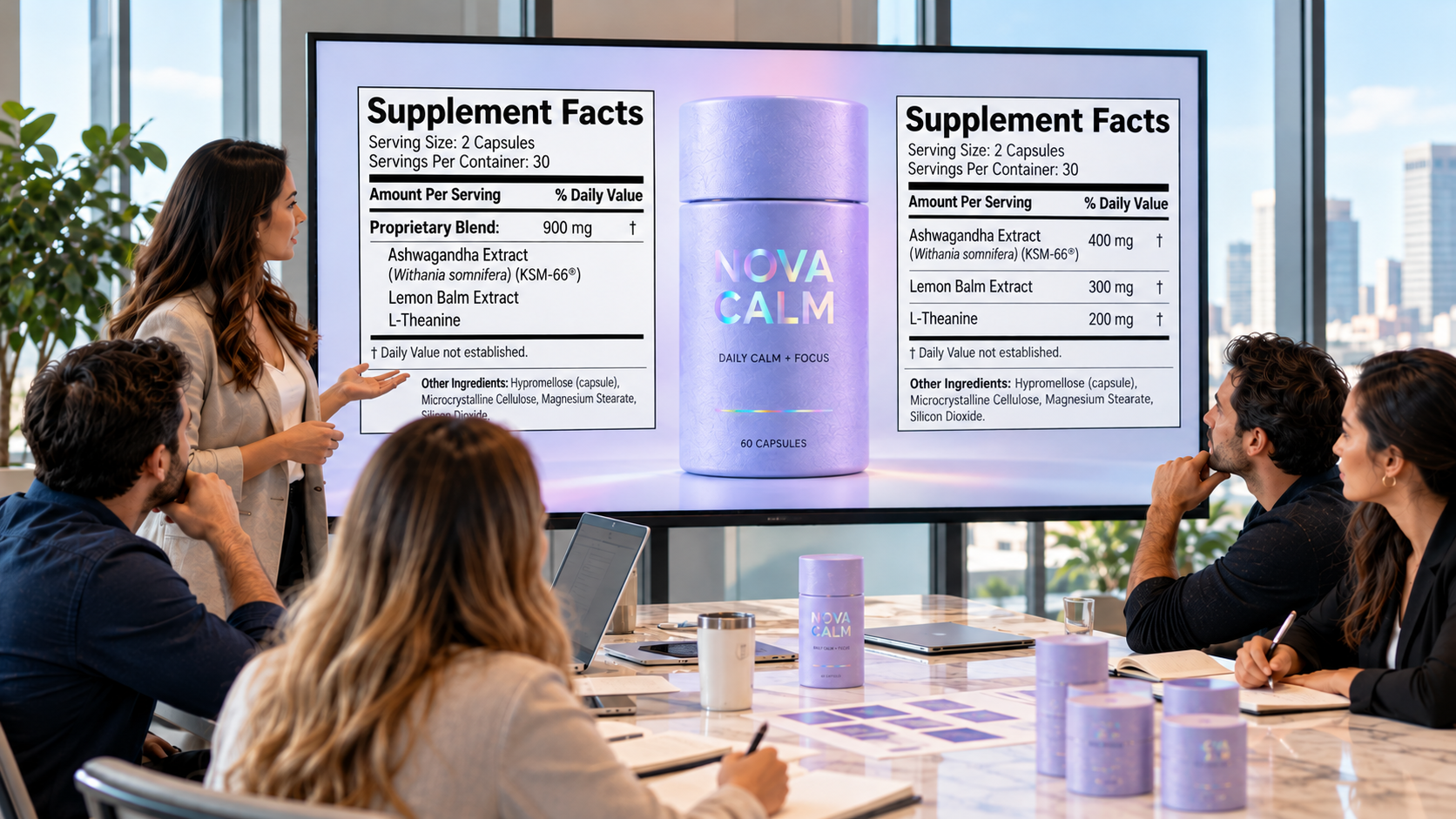
Discovering these limitations after packaging has been finalized can create avoidable complications. A brand that has already designed its product around a 60-capsule bottle may need to revise its Supplement Facts panel, source a larger container, and adjust pricing if the formula ultimately requires 120 capsules. If packaging materials have already been ordered, those changes can introduce additional costs and delays.
The goal is to establish a realistic product configuration before major development decisions become difficult to reverse. A formula supported by research still needs to fit the physical and commercial requirements of the finished supplement.
Bring Your Supplement Formula Into Production
Next Day Nutra helps supplement brands evaluate formulation and manufacturing considerations, from ingredient selection and capsule feasibility to commercial production. Our team works with brands to identify practical manufacturing requirements before they become costly changes later in development.
Industries
Recent Posts