Industry Insights by The Experts
Industry Intelligence from the Disruptors Redefining Private Label Manufacturing
Supplement Stability Testing: What It Tells You About Shelf Life
Industry: Creators, Scaling Operators, Multi-Location, Medical Groups
The Date on the Label Needs a Defensible Starting Point
A shelf-life date affects how much inventory a supplement brand can carry, which sales channels it can support, and how much time customers have to use the product. Before the brand relies on that date, it needs evidence that the finished product can maintain its quality throughout the stated period.
Shelf life describes how long a finished supplement is expected to remain within its established specifications and support its label claims when stored as directed in the package sold to consumers. Products change gradually, so the date does not mark the exact day a product begins to lose potency, change texture, absorb moisture, or develop another quality problem. It defines the period supported by the available evidence.
A brand may begin product development with a target such as 18 or 24 months. That target can reflect retailer expectations, distribution timelines, experience with similar products, or the amount of time the company expects to need to sell through a production run. These familiar timeframes can be useful planning assumptions, but they do not automatically apply to every formula, dosage format, or package.
The FDA’s dietary supplement cGMP compliance guide confirms that dietary supplement companies are not required to establish an expiration, shelf, or best-if-used-by date. When a company chooses to place one on the label, however, it should have data supporting that date.
Eugene Ung, CEO of Best Formulations, described the commercial reality in Nutritional Outlook:
“Brands have an expectation of printing an expiration date anyway, and the date needs to be substantiated by stability studies.”
Retailers, distributors, practitioners, and consumers want to know how long they can expect the product to maintain its quality. A brand may use ingredient documentation, experience with similar formulas, and preliminary data to set an initial target. Whether that target is reasonable depends on the finished formula, manufacturing process, dosage format, packaging, and storage conditions.
Stability testing shows whether the finished product continues to meet its established specifications over time. The results may support the proposed period, point to a shorter one, or eventually support an extension. To understand what those results mean, the brand first needs to know what the study measures.
Stability Testing Evaluates More Than Potency
Finished-product testing can show that a batch meets its specifications when it is released. Stability testing asks a different question: Will the product continue to meet the relevant specifications as it moves through storage, distribution, and consumer use?
That distinction matters because a passing release result captures one point in time. The product may leave the facility with the correct ingredient amounts, acceptable microbiological results, and the intended appearance. Over the following months, its ingredients can interact with one another, its physical characteristics can change, and its packaging can allow exposure to moisture, oxygen, light, or heat.
A stability study follows selected characteristics at planned intervals. The testing should use the finished product in the packaging intended for sale because the formula and container work together throughout the product’s life. Results from an ingredient supplier or an unpackaged formula can provide useful background, but they cannot fully represent how the marketed product will perform.
Depending on the formula and dosage format, a stability program may evaluate:
- Potency: Whether the ingredients being monitored remain within their established limits.
- Appearance and sensory quality: Whether the product develops changes in color, flavor, odor, or general appearance.
- Physical performance: Whether capsules remain intact, tablets continue to disintegrate properly, powders continue to flow and mix as intended, or gummies maintain an acceptable texture.
- Moisture and water activity: Whether moisture changes contribute to clumping, texture problems, ingredient degradation, or microbial growth.
- Microbiological quality: Whether the product continues to meet its established microbial specifications.
- Preservative effectiveness: Whether a required preservative system remains effective.
- Packaging performance: Whether the container, closure, seal, liner, or other packaging components continue to protect the product.
The appropriate combination depends on the product. A gummy may remain within its potency specification while becoming too hard, sticky, or discolored to provide an acceptable experience. A change like that can limit the product’s usable shelf life even when the monitored ingredient amount remains within range.
The American Herbal Products Association’s guidance on shelf-life dating similarly identifies chemical, physical, microbiological, and sensory characteristics such as appearance, odor, and taste as possible parts of a stability program. The guidance emphasizes that testing should reflect the product, its ingredients, its packaging, and the conditions under which it will be stored.
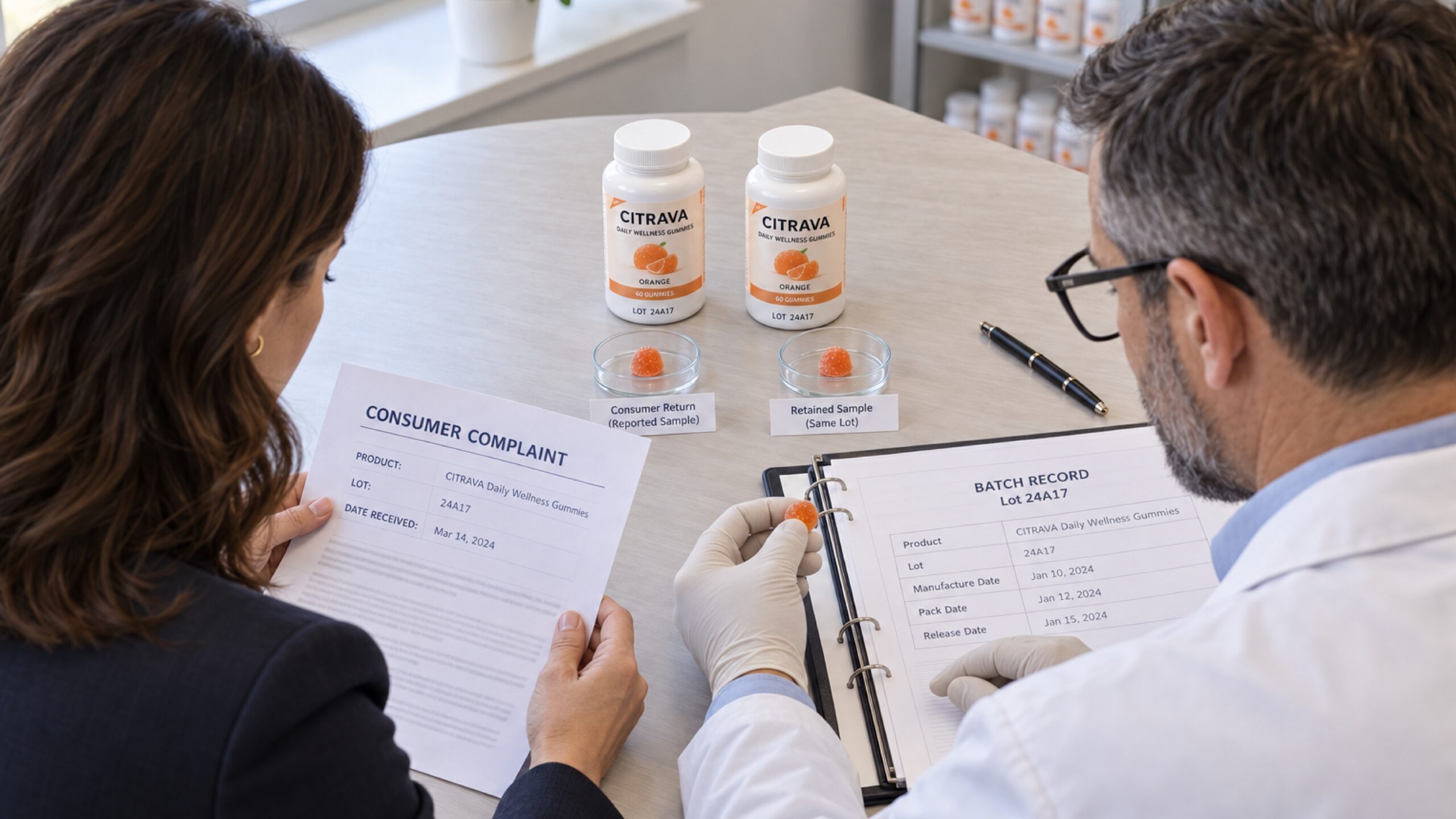
This is why a certificate of analysis cannot establish shelf life on its own. A COA may document that an ingredient or finished batch met selected specifications when it was tested. It does not show how those results will change over the following months or whether the product will continue to perform acceptably in its final package.
The characteristics most likely to change should determine what to test for. The timing and storage conditions then determine the type of evidence the study produces. Accelerated and real-time studies serve different purposes within that process.
Accelerated and Real-Time Stability Studies Serve Different Purposes
A supplement brand rarely wants to wait two years before launching a product with a proposed two-year shelf life. Stability programs address that timing challenge by combining information gathered under accelerated conditions with results collected under the product’s intended storage conditions.
Accelerated stability testing places the finished product in controlled conditions intended to increase the rate of change. Elevated temperature, humidity, or other environmental stress may reveal vulnerabilities involving potency, moisture, color, flavor, texture, or packaging earlier than they would appear under normal storage.
Those results can help the brand and its manufacturing partner identify problems while the formula or package can still be adjusted. A product that absorbs moisture quickly may need a stronger packaging barrier or a desiccant, while a light-sensitive formula may require opaque packaging.
Accelerated data can also contribute to an initial shelf-life decision when supported by product knowledge, relevant experience, and a defined testing protocol. The results still represent the product under stressed conditions. They cannot reproduce every change that may occur during months or years of actual storage.
Real-time stability testing follows the product under its intended storage conditions. Samples are evaluated at planned intervals throughout the proposed shelf life, allowing the brand to observe how the finished product behaves over the same period it may spend in inventory, distribution, and consumer hands.
The two approaches answer different questions:
- Accelerated testing can provide earlier warning of potential problems and help guide initial formulation, packaging, and shelf-life decisions.
- Real-time testing shows whether the product continues to meet its specifications under the conditions and timeframe the shelf-life date is meant to represent.
The results should be reviewed together. If the real-time results begin approaching a limit sooner than expected, the brand may need to reconsider the assigned shelf life, packaging, storage instructions, or future production.
The testing schedule should be established before samples enter the study. The protocol should identify the product and batches being evaluated, the packaging configuration, storage conditions, testing intervals, analytical methods, specifications, and acceptance criteria. The study plan should also include enough samples for every scheduled interval, including later testing if the brand may eventually seek a longer shelf life.
Without that preparation, a brand may reach the end of its initial period and discover that the necessary samples were never retained, the final package was not included, or an important product characteristic was not monitored. By the time one of these gaps is discovered, months of usable data may already be missing.

The Formula, Format, and Package Shape the Stability Study
Stability data apply most directly to the exact formula and package that were tested. Changes to the formula, manufacturing process, dosage format, packaging, or storage conditions may affect how the product ages. The original study may no longer support the changed product.
The ingredients create the first set of stability concerns. Some ingredients are sensitive to heat, moisture, oxygen, light, or changes in pH. Others may remain stable on their own while behaving differently when combined with minerals, botanical extracts, flavors, sweeteners, acids, or other components. The amount of each ingredient and the way the ingredients interact can influence which part of the product changes first.
The dosage format changes those risks. Gummy production can expose ingredients to heat and moisture, while the finished product must maintain an acceptable texture throughout its shelf life. Powders may contain ingredients with different particle sizes, densities, flavors, and moisture sensitivity. Capsules and tablets introduce their own requirements involving shell integrity, hardness, friability, and disintegration. Liquids may depend more heavily on pH control, preservation, and protection from oxidation.
Manufacturing decisions can influence those risks before the product enters its package. Processing temperatures, mixing order, drying, holding time, and exposure to the surrounding environment may affect the finished product. The batches placed into the study should be made using the process the brand expects to use at scale.
Packaging then determines how much protection the product receives during storage and distribution. The container material, wall thickness, closure, liner, seal, desiccant, and amount of headspace can influence exposure to moisture, oxygen, and light. A package that works well for a stable capsule formula may offer insufficient protection for a moisture-sensitive powder or a soft chew.
The brand also needs to evaluate how the package will be used. A bottle may be opened repeatedly for several months, while individual stick packs remain sealed until each serving is needed. A large container may spend more time open in a humid environment than a smaller monthly supply. These differences can affect the conditions the product encounters after purchase, even when both packages contain the same formula.
Storage instructions should match the conditions the study is intended to support. Those conditions should also reflect a realistic path through warehousing, shipping, retail storage, and consumer use. A general direction to store the product in a cool, dry place cannot compensate for packaging that offers inadequate protection during normal distribution.
Because these risks differ by product, one study design cannot fit every supplement. The appropriate tests, storage conditions, intervals, and acceptance criteria depend on the formula and how it is expected to be used. A simple capsule formula may require a different study from a multi-ingredient gummy, flavored powder, probiotic, or liquid.
Any meaningful change made after the study begins should be reviewed and documented. A new ingredient supplier, revised flavor system, different dosage format, manufacturing adjustment, or packaging change may affect the existing data. The review should determine whether those data still apply, whether additional testing is needed, or whether a new study should begin.
Shelf Life Affects How Much Time the Brand Has to Sell the Product
Some of a product’s shelf life will pass before it is available for sale. Finished-product testing, quality review, transportation, receiving, and distribution all take time. The longer the path to the customer, the less shelf life remains when the product arrives.
A product can move through several stages before it is used:
- The manufacturer completes production, finished-product testing, and quality review.
- The released inventory moves to the brand, distributor, fulfillment center, practitioner, or retailer.
- Each receiving organization processes and stores the inventory before making it available.
- The customer purchases the product and may use it over several weeks or months.
Everyone in that chain needs enough time to receive, store, sell, or use the product. A retailer or distributor may require a certain amount of shelf life to remain when inventory arrives. A practice stocking supplements onsite needs time to sell the product and give patients time to use it. A customer purchasing several months of product needs to be able to finish it as directed. In a DTC model, inventory can become available for sale when it reaches the brand’s fulfillment operation. Inventory intended for retail may spend additional time moving through a distributor, retailer receiving system, regional warehouse, and store shelf. International distribution can introduce longer transportation, customs, registration, and receiving timelines.
A larger production run may lower the cost per unit, but the brand still needs enough demand to sell that inventory on time. A slower-than-expected launch, delayed retailer placement, or missed seasonal window can leave the company holding products that meet their specifications but no longer satisfy a channel’s remaining-shelf-life requirements.
This makes sell-through planning part of the shelf-life decision. The brand should compare its proposed production quantity with realistic sales velocity, channel lead times, reorder timing, and the amount of finished inventory already in the system. That comparison can show whether a larger run is realistic, a smaller first order is safer, or a longer shelf life would materially reduce inventory risk.
When several production runs are in circulation, the brand and its fulfillment partners need to know where each lot is stored and which date applies to it. Shipping older eligible inventory first can reduce avoidable aging, provided the receiving channel will still accept it.
A longer shelf life creates more room for distribution and inventory planning. The product still needs evidence showing that it remains within specification for that additional time.
Continued Testing May Support a Shelf-Life Extension
The initial shelf life can sometimes be extended as more real-time data becomes available. A brand may begin with a conservative date based on the information available at launch, then continue collecting real-time data after that point. If the product remains within the study’s acceptance criteria, the additional results may support a longer period.
That opportunity needs to be planned. The study must include enough finished-product samples for testing beyond the original date, and those samples must remain in the specified packaging and storage conditions. If the study uses all of its retained samples by the original endpoint, there will be no samples left to test at later intervals.
Consider a product launched with an initial 18-month shelf life. The stability protocol may also schedule testing at 24 and 30 months. If the later samples continue to meet the relevant chemical, physical, microbiological, sensory, and packaging requirements, the quality team may have enough evidence to consider an extension.
The American Herbal Products Association’s guidance on shelf-life dating recognizes that later testing may demonstrate greater stability than originally expected. The decision still needs to reflect the full set of results collected under the stability program.
Potency testing at the original endpoint provides useful information, but potency is only one part of the review. The formula may retain the monitored ingredient amount while developing changes in texture, flavor, moisture, disintegration, microbial quality, or package performance. A single passing result also provides less information than a series of results showing how the product behaved across multiple intervals.
Trends deserve attention even when individual results remain within specification. A measured ingredient that is steadily approaching its lower limit may warrant more caution than one that has remained consistent. Similar patterns involving moisture, texture, or other product characteristics can help the quality team judge how much additional time the available evidence reasonably supports.
The data also need to match the product being evaluated. Results from one formula, package, or manufacturing process may not support a later version that has changed in a meaningful way. An extension should account for any supplier changes, reformulation, process adjustments, or packaging revisions made while the study was running.
A documented quality review should determine how the additional data affect the assigned shelf life and the product lots to which that decision applies. A need to move aging inventory is not evidence for extending the date. The decision should follow the stability results.
Planning later testing intervals preserves the possibility of an extension. The product may support a longer period, or the results may confirm that the original date remains appropriate. Either outcome provides useful information for future production, packaging, and inventory planning.
Stability Planning Should Begin Before the First Production Run
Stability planning should begin while the formula, packaging, and production plan can still change. The proposed period should also reflect how the product will be sold. A brand seeking a 24-month shelf life for retail distribution may need a different plan from one producing smaller quantities for direct-to-consumer sales. Defining that commercial need early gives the team room to build the study around it.
The manufacturing partner can then help identify how the formula, dosage format, process, and packaging may affect that target. The testing laboratory can confirm suitable methods, sample quantities, storage conditions, and testing intervals. The brand’s quality team or designated reviewer needs to understand how results will be evaluated and who has the authority to approve the final shelf-life decision.
“Some of the most important stability results may not be available until months after launch. If those results reveal a problem after the formula, package, and inventory are committed, the remaining options are fewer and usually more expensive.”
— Steven Anderson, Founder and CEO of Next Day Nutra
Before production, the parties should be able to answer several practical questions:
- What shelf-life period is the business trying to support?
- Which product characteristics and label claims need to remain within specification?
- Will the study use the exact formula and packaging intended for sale?
- Which accelerated and real-time conditions and intervals are included?
- How many batches and samples will be required?
- Will samples be reserved for testing beyond the initial shelf life?
- Who will receive, review, and retain the results?
- How will unexpected, out-of-specification, or unfavorable trends be handled?
- Which formula, supplier, process, or packaging changes would require additional review or testing?
The team should document who is responsible for each part of the study. A contract manufacturer may coordinate testing, retain samples, or work with an outside laboratory. The brand still needs access to the protocol and results supporting the date on its label. Clear roles prevent samples, records, test results, and final decisions from being divided among organizations without an obvious owner.
A product change after launch may affect whether the original stability data still apply. Moving from a bottle to a pouch, replacing an ingredient supplier, revising a flavor system, or adjusting the manufacturing process may improve cost or availability while changing how the product behaves over time. Reviewing the change before implementing it can show whether the existing data are sufficient or additional testing is needed.
Early coordination helps ensure that the study includes the necessary samples, methods, testing intervals, and responsible parties. The data can then show whether the product supports the preferred shelf life and whether later results could justify an extension.
Shelf Life Should Be Planned as Part of the Product
A shelf-life date is useful when the evidence reflects the finished formula, the package consumers receive, and the conditions the product is likely to encounter. That evidence also gives the brand clearer limits for inventory, distribution, and channel planning.
Building the stability program before production allows the brand to select appropriate tests, begin real-time monitoring on schedule, and retain samples for possible later testing.
Next Day Nutra helps supplement brands plan for stability alongside formulation, manufacturing, packaging, testing coordination, and production planning.
Industries
Recent Posts