Industry Insights by The Experts
Industry Intelligence from the Disruptors Redefining Private Label Manufacturing
The Founder’s Dilemma: Custom Formulation vs Private Label Supplements
Industry: Creators Multi-Location

For founders entering the supplement space, one of the earliest and most important decisions is how to approach product development:
Should you invest in custom supplement formulation, or start with private label supplements?
On the surface, the answer can feel obvious.
Custom formulation is often associated with premium brands.
It offers control, differentiation, and the ability to create something unique.
Private label supplements, or pre-formulated stock products, are seen as faster and easier to launch, but less differentiated.
So the assumption becomes:
If you want to build a real brand, you go custom.
But that assumption often leads to the wrong decision.
For founders learning how to start a supplement brand, this choice shapes everything from cost structure to speed to market. And when it’s made based on perception instead of context, it can introduce constraints that slow down growth before the business has even taken shape.
Why the Custom vs Private Label Supplements Decision Gets Misframed
Most founders evaluate the decision between custom supplement formulation and private label supplements through a narrow lens:
- custom equals differentiation
- private label equals commoditized
But in practice, both paths can succeed or fail depending on how they are used.
Custom supplement formulation does not guarantee a differentiated brand.
Private label supplements do not prevent one.
What matters is how the product fits into a broader system:
- how it is positioned
- how it is experienced
- how it is integrated into a customer’s routine
Without that system, even the most unique formulation struggles to gain traction.
And with the right system, private label supplements can still become part of a differentiated and scalable brand.
“Custom formulation gives you more control, but control only matters if the business can actually execute on it.” — Steven Anderson, CEO, Next Day Nutra
The Hidden Cost of Custom Supplement Formulation
Custom supplement formulation introduces something that is often underestimated early on:
- Complexity.
- More decisions.
- Longer timelines.
- Higher upfront investment.
- More coordination across sourcing, testing, and production.
Each of these adds friction to execution.
And while that complexity can be valuable at the right stage, it can also slow down the one thing early-stage brands need most:
momentum.
As McKinsey notes,
“the proliferation of niche products and the endless creation of new variants often result in lower-than-expected profitability.”
Customization becomes a problem when it’s introduced before the business is ready to absorb it.
What looks like differentiation on paper can translate into slower launches, delayed feedback, and higher risk in practice.
The Tradeoff: Custom Formulation vs Private Label Supplements
At its core, the decision between custom supplement formulation and private label supplements (stock products) is a tradeoff: control versus speed.
Custom formulation offers control. You can shape the product, refine the formula, and build something that is uniquely yours.
Private label supplements offer speed. You can launch faster, validate demand, and start learning from real customers sooner.
Neither approach is inherently better.
The question is which advantage matters more based on your current stage, market conditions, and available resources.
Because in many cases, the biggest risk is not choosing between custom formulation and private label supplements.
It’s choosing the right approach at the wrong time.
What Should Actually Drive the Decision
The decision between custom supplement formulation and private label supplements is often framed as a product choice.
In reality, it’s a business decision.
And the right answer depends less on preference and more on context.
There are four variables that should drive the decision:
1. Audience Expectations
Not all customers evaluate products the same way.
Some audiences are highly ingredient-aware.
They understand formulations, compare labels, and look for specific compounds or dosages.
Others are outcome-driven.
They care more about how the product fits into their routine and whether it delivers a consistent experience.
This distinction matters.
If your audience is deeply educated on formulations, custom supplement formulation may play a more meaningful role in differentiation.
If not, differentiation is more likely to come from positioning, branding, and experience.
Many founders overestimate how much their audience actually evaluates formulation details, and underestimate how much they respond to clarity, consistency, and trust.
2. Market Saturation and Competitive Pressure
The more crowded the category, the more founders feel pressure to differentiate through the product itself.
But this is where decisions often become reactive.
In saturated markets, custom supplement formulation can help create meaningful differentiation, but only if the difference is clear and relevant to the customer.
Incremental changes that are difficult to communicate or understand rarely create an advantage.
At the same time, in less saturated or emerging niches, speed and execution can matter more than uniqueness.
Being first to establish positioning, messaging, and customer relationships often creates more leverage than having a more complex formulation.
Differentiation is not just about being different.
It’s about being understood.
3. Timing and Speed to Market
Speed is one of the most undervalued advantages in early-stage brands.
Private label supplements allow founders to:
- launch faster
- test demand earlier
- iterate based on real customer feedback
Custom supplement formulation introduces longer timelines:
- formulation development
- ingredient sourcing
- testing and validation
- production setup
These steps are valuable, but they delay feedback.
In the absence of feedback, founders are making decisions in isolation.
Early-stage brands benefit from shortening the distance between decision and learning.
Because the faster a founder can learn what resonates with customers, the faster they can refine the business.
Custom formulation can slow that learning loop if introduced too early.
4. Capital and Risk Tolerance
Custom supplement formulation requires a higher level of upfront investment.
Not just financially, but operationally.
More capital is tied up before the product reaches the market.
More assumptions are made before validation.
More risk is carried before feedback.
Private label supplements reduce that exposure.
They allow founders to validate demand with lower upfront commitment and adjust more easily based on performance.
This doesn’t mean private label is always the better choice.
But it does mean founders need to be honest about:
- how much capital they can deploy
- how long they can operate before seeing returns
- how much risk they are willing to carry
Because the wrong decision here doesn’t just impact the product.
It impacts the entire trajectory of the business.
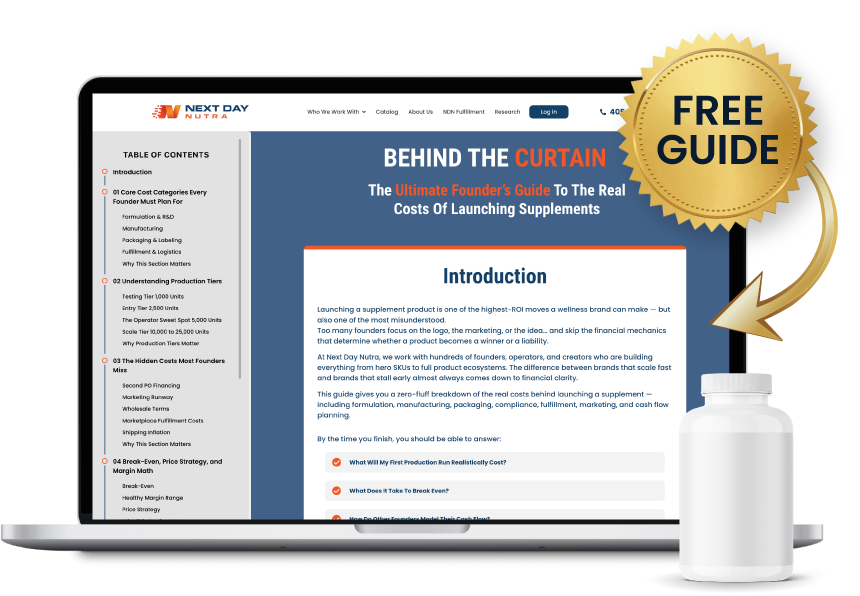
It is critical to understand your cost structures early, especially when evaluating custom formulation versus private label.
Where Founders Get This Wrong
The mistake isn’t choosing custom formulation or private label supplements.
The mistake is choosing based on assumption instead of alignment.
Some founders choose custom too early.
They invest in differentiation before they’ve validated demand.
They optimize the product before they understand the customer.
They add complexity before the business can absorb it.
Others avoid custom for too long.
They rely on private label supplements even when the brand has reached a stage where differentiation and control would create leverage.
Both are forms of misalignment.
Because the decision is not static.
It evolves with the business.
Differentiation Doesn’t Start With the Formula
One of the most persistent misconceptions in supplement brand strategy is that differentiation comes primarily from formulation.
In reality, formulation is only one layer.
Brands differentiate through:
- how clearly they define the problem
- how specifically they position the product
- how consistently they deliver the experience
- how effectively they guide the customer toward results
These are the systems that ultimately determine whether a brand can scale effectively.
A product can be custom and still feel generic if the surrounding system is weak.
A product can be private label and still feel differentiated if the system around it is strong.
This is where many founders misallocate effort.
They focus on building a better product, instead of building a better experience around the product.
The formula is not the brand. The system around it is.
When Custom Formulation Actually Creates Leverage
Custom supplement formulation becomes valuable when it solves a problem that has already been validated.
Not when it is used to create the initial differentiation.
It creates leverage when:
- you understand your customer deeply
- you know what outcomes they care about
- you can translate that into a formulation that is both meaningful and communicable
- you have the operational infrastructure to support it
At that stage, customization is not guesswork.
It is refinement.
It strengthens the brand instead of complicating it.
When Private Label Supplements Are the Right Strategic Move
Private label supplements are often seen as the faster and simpler path to market.
And in terms of product development, they are.
They allow founders to launch quickly, validate demand, and begin learning from real customers without the delays of custom supplement formulation.
But speed shifts where complexity shows up.
With private label supplements, the burden moves away from formulation and into execution.
Because when the product itself is not the primary differentiator, performance depends on how effectively the brand can test, position, and optimize in the market.
This is where many brands are starting to treat private label as a strategic advantage rather than a shortcut.
At launch, this requires active monitoring and iteration.
- Testing multiple products.
- Testing different audiences.
- Testing messaging and offers.
Each of these generates data.
If that data isn’t tracked and interpreted accurately, speed turns into noise instead of insight.
This is where many founders misjudge private label.
Faster launch does not mean less work.
It means a different kind of work.
The Cost of Learning Faster
Private label supplements allow brands to learn faster.
But that learning comes at a cost.
Running multiple products, campaigns, and offers in parallel requires enough marketing spend to generate meaningful data.
At low volume, it becomes difficult to determine what is actually working.
When clarity is missing, decisions become reactive instead of strategic.
This creates a second layer of pressure:
the need to balance experimentation with capital efficiency, while remaining flexible enough to adjust quickly based on results.
What This Means in Practice
Private label is most effective when the brand has the capability to:
- launch and test quickly
- track performance across products and campaigns
- analyze data with accuracy
- adjust positioning and targeting based on real insights
Without these capabilities, speed lacks direction.
How to Choose Between Custom Formulation and Private Label Supplements
By this point, the decision should feel less binary.
The question is which path aligns with your current constraints and capabilities.
Instead of asking:
Should I choose custom supplement formulation or private label supplements?
The better question is:
What does my business need most right now?
If your priority is speed and validation
Private label supplements may be the better fit.
They allow you to:
- enter the market quickly
- test demand with less upfront investment
- learn what resonates before committing to complexity
But they also require:
- strong execution
- data tracking and analysis
- sufficient marketing spend to generate meaningful insights
In those conditions, speed stops translating into meaningful progress.
If your priority is differentiation and control
Custom supplement formulation can create leverage.
It allows you to:
- build a product tailored to a specific outcome
- create meaningful differentiation in competitive markets
- develop long-term defensibility
But it also requires:
- longer timelines
- higher upfront investment
- confidence in your positioning and customer understanding
Lack of clarity turns customization into guesswork.
If You’re Operating Between Both Paths
Not every brand fits cleanly into one approach.
Some founders choose private label supplements to move quickly and validate demand.
Others go directly into custom supplement formulation because their audience, positioning, or capital structure supports it from the start.
In some cases, brands evolve over time.
In others, they stay in one lane and build differentiation through execution.
There is no fixed progression. Only alignment to context.
The decision is not about choosing the “right” option.
It’s about choosing the option that aligns with your current reality.
Final Perspective
Founders often focus on getting the product right.
But the product is only one part of the system.
And choosing between custom formulation and private label supplements doesn’t change that.
The outcome depends on how well that decision aligns with:
- your audience
- your market
- your timing
- your resources
- your ability to execute
Make the Right Decision Before You Commit
If you’re building or scaling a supplement brand, this decision shapes how your business operates from day one.
It impacts your cost structure, your speed to market, and your ability to adapt as the business grows.
We work with brands to evaluate their current position and determine which approach makes the most sense based on their goals, market, and resources.
If you want clarity before you commit:
Industries
Recent Posts