Industry Insights by The Experts
Industry Intelligence from the Disruptors Redefining Private Label Manufacturing
The Franchise Formula: How Multi-Unit Brands Use Private Label to Drive Consistency and Loyalty
Industry: Multi Location
For franchise brands, loyalty is one of the most valuable assets they can build.
Customer acquisition is expensive, and the economics of growth often depend on how well a brand can keep customers engaged over time.
Harvard Business Review reports that acquiring a new customer can cost five to twenty-five times more than retaining an existing one.
Source: Harvard Business Review
For service-based brands such as gyms, medspas, and wellness clinics, this dynamic creates a unique challenge. Customer visits are often spaced out, whether that’s weekly, monthly, or tied to a specific treatment plan. Without additional touchpoints, the brand can fade from the customer’s daily routine between visits.
That gap is where many multi-location companies are beginning to rethink how they build loyalty.
Increasingly, retail products and private label offerings are becoming powerful tools for strengthening customer relationships while expanding revenue at the same time.
Many brands are beginning to treat private label not just as retail, but as a broader operational strategy. We explore that shift further in Private Label 2.0: How Smart Brands Are Turning Operations into New Revenue Streams.
Why Retail Products Reinforce Loyalty
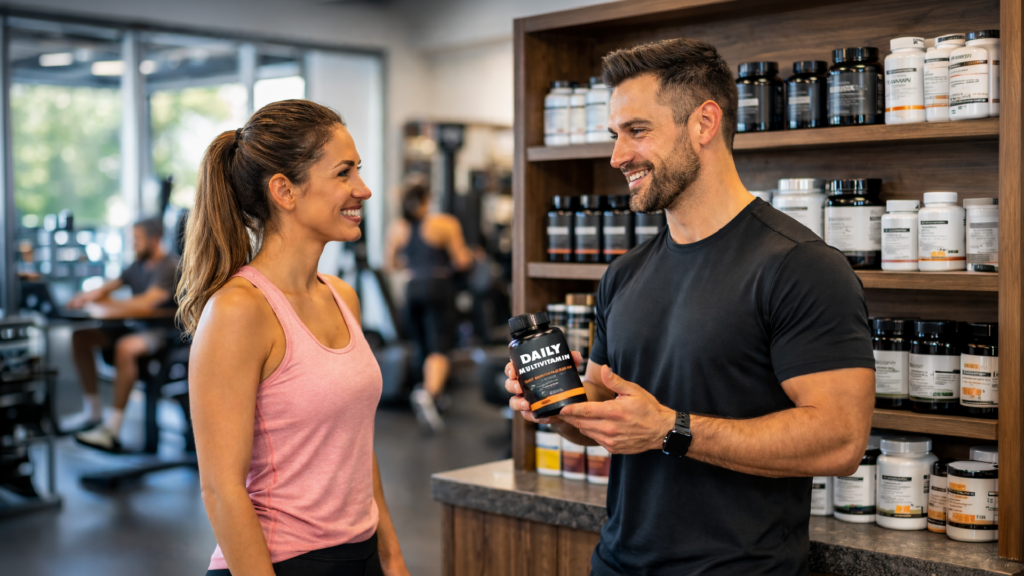
When customers bring a product home from a studio or clinic, the relationship with the brand changes.
The brand is no longer something they experience occasionally. It becomes part of their daily routine.
- A supplement taken every morning.
- A hydration product used after workouts.
- A skincare product used after a treatment.
These products extend the brand experience beyond the physical location. They reinforce the value of the service and keep the brand present in the customer’s life between visits.
As Tiffany Chang, Lead Marketing Strategist at Next Day Nutra, explains:
“When customers bring a product home from a brand they trust, the relationship changes. The brand stops being something they visit occasionally and becomes part of their daily routine. That daily interaction strengthens loyalty because the brand now lives inside the customer’s habits, not just inside a location.”
For multi-site brands and franchise networks, this creates an important opportunity. Retail products do not simply generate incremental revenue. They reinforce the habit loop that drives long-term loyalty.
When customers consistently interact with the brand outside of the service environment, retention becomes stronger and the brand relationship deepens.
Why Increased Customer Spend Signals Stronger Loyalty
One of the clearest indicators of loyalty is not just repeat visits. It is increased customer spend over time.
Customers who trust a brand tend to expand their relationship with it. They purchase additional services, try recommended products, and incorporate the brand more deeply into their routines.
Retail products make this expansion possible.
A service business is naturally limited by time and capacity. There are only so many appointments, classes, or sessions a location can deliver each day. Retail products remove that constraint by allowing customers to engage with the brand outside of scheduled visits.
This turns a single revenue stream into a broader ecosystem of engagement.
For companies & brands operating across multiple sites, that shift can dramatically change the economics of the business model.
Why Consumable Products Are Especially Powerful
Not all retail products are created equal.
The most effective retail strategies often focus on consumable products, particularly categories like dietary supplements, hydration formulas, and beauty or wellness products.
Consumables have a built-in advantage. Customers do not purchase them once. They purchase them repeatedly.
Once a product becomes part of a routine, it naturally creates:
- repeat purchases
- subscription opportunities
- predictable revenue
- deeper customer engagement
A supplement used daily, for example, may be reordered every 30 to 60 days. When a brand successfully integrates these products into the member experience, it creates an additional layer of recurring revenue that operates alongside the core service.
For growing networks of studios, clinics, or wellness centers, this can unlock significant revenue growth across locations.
If you want to see how this works financially, you can explore the Multi-Location Supplement Revenue Simulator, which models how retail products can impact revenue across a network of locations.
Which Businesses Benefit Most from Private Label Retail
Franchise systems are not the only organizations that benefit from retail products.
Any company operating across multiple locations faces the same fundamental challenge: maintaining a consistent customer experience while increasing customer lifetime value.
Retail products, particularly consumable products like dietary supplements, hydration formulas, skincare products, or pet wellness supplements, can help solve both problems.
Many multi-location companies and multi-site brands eventually discover that services alone create a natural ceiling on revenue due to labor, space, or schedule constraints. Retail products allow those businesses to expand revenue while strengthening customer relationships between visits.
Some of the most successful retail programs appear in industries where customers already trust the brand for guidance and recommendations.
Fitness studios and gyms
Studio networks focused on performance, recovery, or specialized training often introduce hydration products, recovery supplements, and performance formulas that support their programming and reinforce the workout experience.
Wellness clinics and recovery centers
Multi-site wellness brands offering IV therapy, recovery services, or longevity treatments frequently introduce supplements and functional beverages aligned with their treatment protocols.
Medspas and aesthetic clinics
Many aesthetic clinic networks extend their services with skincare products, collagen supplements, and beauty-focused wellness formulations that support treatment results.
Hair salons and beauty studios
Salon networks often develop branded hair care products, scalp treatments, and wellness supplements designed to support hair health while extending the salon experience at home.
Veterinary clinics, grooming businesses, and dog daycare brands
Pet wellness supplements and nutritional products allow veterinary and grooming networks to extend the relationship with pet owners while supporting long-term pet health.
Hospitality and lifestyle brands
Resorts, spas, and wellness-focused hospitality brands are increasingly introducing branded wellness products that allow guests to continue the experience after they leave.
In each of these industries, the dynamic is the same. Customers trust the brand because of the service experience. Retail products extend that trust into everyday routines.
For multi-site brands and service networks, private label products allow those experiences to remain consistent across locations.
The Typical Challenges Multi-Location Brands Encounter
Despite the potential, many multi-location companies and multi-site brands struggle to implement retail programs successfully.
The challenge is rarely the idea. Most operators understand that retail products can increase customer spend and strengthen loyalty. The real barriers are operational.
Retail programs introduce complexity, and without the right systems in place, that complexity can slow growth instead of supporting it.
Common obstacles include:
- Capital Drag
Retail inventory requires upfront investment. Without strong sell-through, cash can become trapped in products that move slowly across locations.
- Supplier Fragmentation
Relying on multiple vendors often creates inconsistent quality, pricing, and accountability.
- Shelf Stagnation
If products are not actively integrated into the customer experience, they sit on shelves and quietly erode margins.
- Sales System Gaps
Retail products rarely sell themselves. Without a repeatable recommendation process, adoption across locations becomes inconsistent.
- Inconsistent Rollouts Across Locations
Some locations embrace retail while others ignore it, creating uneven customer experiences across the network.
- Limited Internal Bandwidth
Many growing brands lack the time, systems, or resources to manage training, onboarding, and reporting across dozens or hundreds of locations.
When these issues stack together, retail programs that were meant to drive growth can instead create operational friction.
Successful multi-location retail strategies rely on centralized systems that simplify manufacturing, distribution, training, and reporting.
Why Private Label Is the Right Foundation
For many multi-location companies, relying on third-party retail brands makes these challenges even harder to solve.
When every location can choose its own products, the experience becomes fragmented. Margins shrink as distributors take their share. Inventory becomes harder to manage. Most importantly, the retail experience stops reinforcing the brand itself.
This is why many multi-site brands and franchise networks eventually move toward private label.
Instead of promoting outside brands, the organization develops its own product line designed specifically for its customers and service model.
This shift creates several strategic advantages.
- Consistency Across Locations
Every location offers the same products, protecting the brand experience across the network.
- Stronger Economics
Private label removes layers of distributor markup, allowing brands to capture significantly higher margins.
- Alignment With the Service Experience
Products can be designed specifically for the brand’s environment and customer journey.
- Performance supplements for fitness studios.
- Recovery and hydration products for wellness clinics.
- Skincare systems for medspas and aesthetic practices.
Some brands develop fully custom formulas, while others start with proven formulations from the Next Day Nutra stock product catalog and customize branding for their locations.
When executed well, private label products stop feeling like retail inventory and start functioning as an extension of the service itself.
However, private label alone does not solve the operational challenges.
Manufacturing, distribution, training, adoption across locations, and performance tracking still require the right infrastructure.
Without that infrastructure, even private label programs can stall before they reach scale.
A Real-World Example: HOTWORX
One example of how this strategy can scale across a network is the launch of custom supplement products for the HOTWORX franchise network.
Proof That Expansion Doesn’t Have to Be Risky
Case Study: Multi-Location 2025
JUN 25’ — Developed and manufactured 10 custom SKUs for HOTWORX
JUN 25’ — Developed custom order portal and online sales tracking
JUL 25’ — Multi-location rollout across the United States
AUG 25’ — More than 200 locations onboarded
NOV 25’ — Over 50% adoption across locations
DEC 25’ — $300,000+ in new revenue generated for franchisees
MAR 26’ — Custom Direct-To-Member eCommerce beta launched
The rollout succeeded because the infrastructure behind it was centralized from the beginning.
Manufacturing, ordering, distribution, and performance tracking were built into a single operational system, allowing locations to adopt the program quickly without adding complexity to franchise operations.
The program was developed and executed with Next Day Nutra, ensuring that manufacturing, fulfillment, and franchise rollout could operate through a coordinated, scalable system.
The Next Evolution of Multi-Location Growth
For many service-based businesses, retail products are shifting from an optional add-on to a strategic growth engine.
When products are integrated into the service experience, they extend the relationship between the brand and the customer beyond the physical location.
- Members use the products at home.
- Customers return to reorder.
- The brand becomes part of a daily routine.
This creates three powerful outcomes for multi-location companies and service networks:
- Stronger Customer Loyalty
Products reinforce the results customers associate with the brand.
- Higher Customer Lifetime Value
Retail offerings increase spend without requiring more appointments or visits.
- Recurring Revenue Potential
Consumable products such as supplements naturally create reorder cycles and subscription opportunities.
For growing multi-site brands and franchise networks, private label supplements make it possible to deliver that experience consistently across every location.
Turning Retail Into a Scalable System
For multi-location companies and franchise networks, the challenge is not simply launching retail products.
The real challenge is building a system that can support those products across dozens or hundreds of locations without creating operational drag.
That means solving the problems that typically stall retail programs:
- Inventory that ties up capital.
- Fragmented suppliers and inconsistent product quality.
- Locations adopting programs unevenly.
- Limited visibility into sales performance.
- Training gaps across expanding networks.
Private label provides the foundation, but infrastructure is what allows the model to scale.
This is where Next Day Nutra operates differently.
Instead of acting as a typical private label supplier, Next Day Nutra builds the operational framework that multi-location brands need to launch and scale retail programs successfully, including:
- Centralized supplement manufacturing designed for brand consistency
- Integrated fulfillment and distribution across locations
- Custom ordering portals and revenue tracking systems
- Scalable rollout strategies for franchise and multi-site brands
- Operational support for training, adoption, and ongoing performance visibility
The result is not just a product line.
It is a retail system designed to scale with the brand.
Ready to Explore Private Label for Your Brand?
If you operate a multi-location brand or service network, retail products can unlock new revenue without requiring additional locations, staff, or services.
To understand what that could look like in your business, explore the Multi-Location Supplement Revenue Simulator and see how retail products could impact revenue across your network.
If you want to discuss how a private label supplement program could integrate into your business model, schedule a consultation with our team.
Industries
Recent Posts