Industry Insights by The Experts
Industry Intelligence from the Disruptors Redefining Private Label Manufacturing
What “Quality” Really Means in Supplements: The Non-Negotiables That Protect Your Brand
Industry: Multi Location, Creators, Scaling Operators
Most supplement brands say they care about quality. The problem is that “quality” has become a vague marketing word instead of a concrete operational standard.
In real life, quality is not a claim. It is a system.
It is the set of controls that ensures your product is safe, consistent, compliant, and repeatable at scale. It is what protects your brand when volume grows, when suppliers shift, when timelines tighten, and when customers reorder expecting the same experience they had the first time.
If you want a quality reputation that survives growth, you need to understand the non-negotiables.
Why “Quality” Gets Misunderstood
Most founders think quality means one of these:
- “We used premium ingredients.”
- “We tested it.”
- “We have a GMP Certified facility.”
- “We passed the lab results.”
Those are pieces of the picture, but none of them alone define quality.
Quality is misunderstood because brands only see the final output, the bottle. They do not see the chain of decisions and controls that determine whether that bottle is trustworthy.
The truth is simple:
- You cannot inspect quality into a product at the end.
- You cannot market your way out of inconsistency.
- You cannot fix late-stage quality problems without paying for them in time, cash, and credibility.
Quality is designed upstream or it fails downstream.
Why Quality Systems Fail in Practice
Quality failures in the supplement industry are rarely isolated incidents. They are almost always the result of weak systems upstream.
Recent FDA inspection data shows that observations tied to dietary supplement manufacturing compliance increased 46 percent from 2023 to 2024, with the most common findings related to deficiencies in documented quality systems under FDA dietary supplement regulations, not one-off production mistakes.
Source: FDA inspection analysis summarized by cGMP Consulting
This data matters because it highlights a systemic issue. Most quality problems do not come from a single bad batch. They come from gaps in how quality is managed across the full product lifecycle.
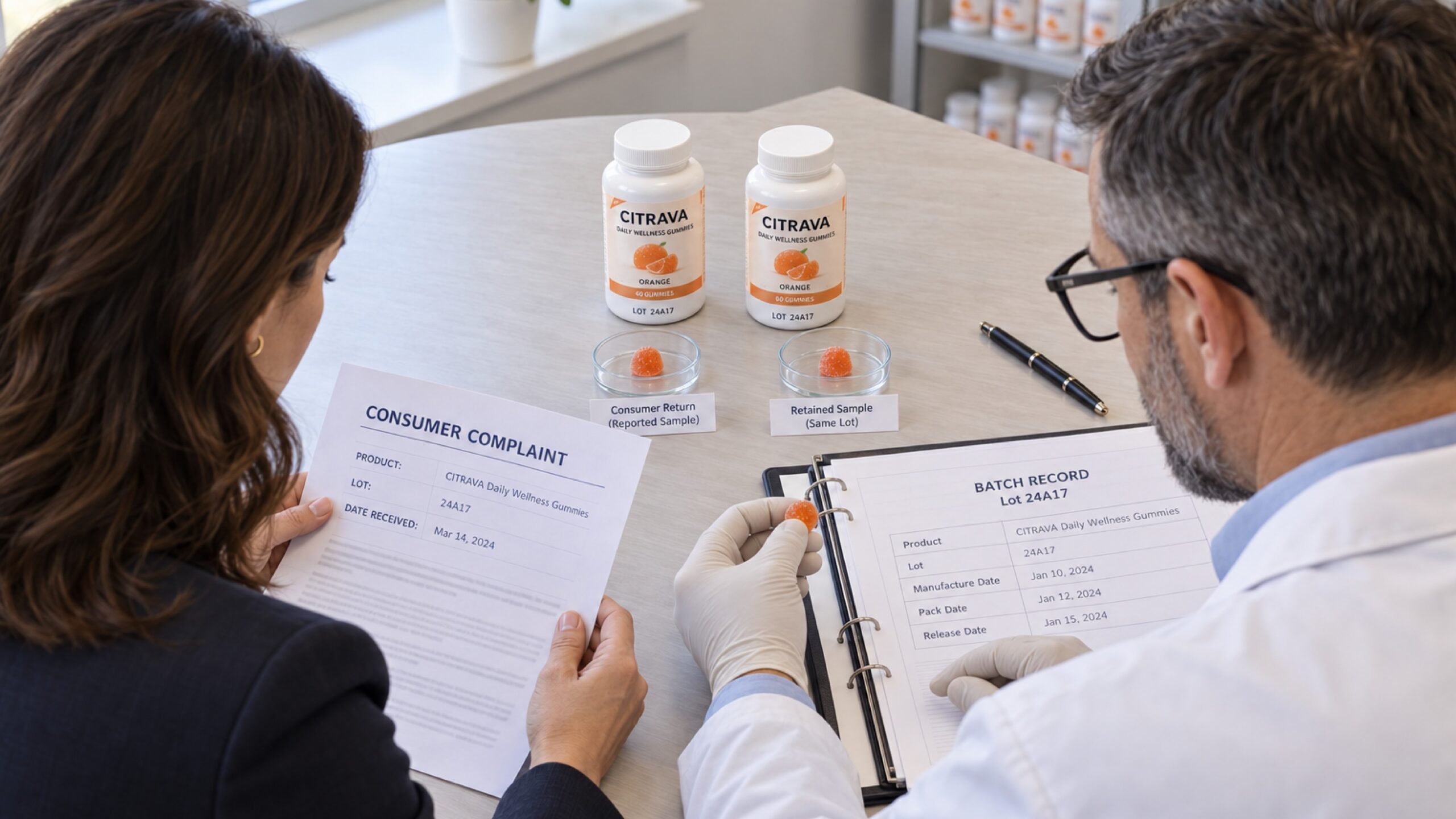
“Most quality issues don’t start on the production floor,” says Brittani Kellogg, Director of Quality Control at Next Day Nutra.
“They start much earlier when decisions are made without considering how formulation, labeling, sourcing, and testing connect. If quality is not built into every stage, it eventually shows up as a failure somewhere down the line.”
This is why quality cannot be treated as a final checkpoint. It must be built into the system from the beginning.
Quality Is a Lifecycle, Not a Checkpoint
In supplements, quality is created across the full product lifecycle:
- Ingredient sourcing and verification
- Formulation design and testing
- Process control during production
- Quality control release criteria
- Packaging integrity and label accuracy
- Storage and fulfillment handling
- Consistency over time, across batches, and at scale
If any one of those breaks, customers feel it. Sometimes immediately. Often on the second or third bottle, which is where brand trust is either reinforced or lost.

Non-Negotiable 1: Ingredient Integrity and Traceability
Ingredient quality is not just “what you buy.” It is what you can prove, repeatedly.
What ingredient integrity actually includes:
- Supplier qualification, not just supplier selection
- Documentation that matches what was received
- Identity verification so you know it is the correct ingredient
- Potency checks so the ingredient performs as expected
- Micro and contaminant controls where applicable
- Lot traceability so you can track what went into each batch
Why this protects your brand:
Because ingredient variability shows up as:
- Inconsistent taste
- Inconsistent results
- Unexpected tolerance issues
- Failed testing
- Delayed batch release
- Customer distrust and refund requests
High-growth brands get burned when they assume “the ingredient is the ingredient.” It is not. Not across suppliers. Not across lots. Not across time.
The brand that wins long-term is the one that treats ingredient integrity like a system, not a hope.
Non-Negotiable 2: Formulation That Holds Up in the Real World
Founders often think of formulation as a list of ingredients. Real quality treats formulation as a performance system.
A formula can look great on paper and still fail the customer experience.
Real-world formulation quality includes:
- Stability over the product’s shelf life
- Mixability and texture for powders
- Taste consistency and flavor durability
- Tolerance, especially for daily-use products
- Dosage practicality so customers can actually stick with it
- Ingredient interactions that can impact efficacy and sensory experience
Why this protects your brand:
Because customers do not reorder “the formula.” They reorder the experience.
If the first bottle tastes one way and the second tastes different, they will not rationalize it. They will just decide you are inconsistent.
If a product works but is unpleasant to take, they will not stay loyal. They will replace you.
Quality formulation is not just about what is included. It is about whether customers can use it consistently and want to.
Non-Negotiable 3: Quality Control Built Into the Process
Many brands treat QC like a gate at the end. That is a risky mindset.
End-of-line QC can only catch what is measurable after production. It cannot fix:
- Ingredient variability that should have been controlled earlier
- Process drift during blending or encapsulation
- Contamination risks caused by poor controls
- Documentation gaps that delay release
- Changes that were made without validation
What strong QC systems look like:
- Defined release criteria with clear pass and fail thresholds
- In-process checks, not just final checks
- Documentation discipline so decisions are defensible
- Deviation handling that is consistent and traceable
- Corrective action that prevents repeat issues
- Change control so adjustments do not create drift across batches
As Brittani Kellogg, Director of Quality Control at Next Day Nutra, explains:
“At low volume, inconsistency can hide. At scale, it surfaces fast. That’s why quality has to be built into every control point. If you rely on final testing alone, you’re reacting. If you build strong systems, you’re protecting the customer experience before it ever drifts”
Why this protects your brand:
Because most quality failures do not show up as a dramatic crisis. They show up as:
- Delayed timelines
- Rework and reprints
- Subtle customer dissatisfaction
- Negative reviews that mention inconsistency
- Reorders that never happen
If your QC exists only at the end, you are always reacting. Strong brands build QC into the process so issues are prevented, not discovered late.
Non-Negotiable 4: Label Accuracy and Compliance Discipline
Quality is also truth.
If your label, marketing, and product do not align, customers eventually notice. Regulators can notice faster.
Compliance is not a side task. It is a quality system because it protects credibility.
Label and compliance quality includes:
- Supplement facts accuracy that matches the formula
- Required statements and formatting done correctly
- Claims discipline so marketing does not outpace reality
- Ingredient naming consistency across panels
- Allergen and warning clarity where applicable
- Version control so the correct label is used every time
Why this protects your brand:
Because the fastest way to lose trust is to create a gap between expectation and reality.
Even when a product performs well, sloppy labeling, questionable claims, or inconsistencies create doubt. Doubt kills loyalty.
Non-Negotiable 5: Consistency at Scale
This is where quality becomes visible.
A brand can look high quality at low volume and still fail at scale. Scale introduces pressure:
- Suppliers change
- Lead times shift
- Production schedules compress
- Teams move faster
- Errors compound
Without systems, “minor” changes sneak in and customers feel them:
- A flavor note shifts
- The capsule looks different
- The powder texture changes
- The effect feels weaker
- The tolerance changes
- The bottle presentation differs
Customers rarely complain with technical language. They say:
- “It’s not the same.”
- “Something changed.”
- “This used to work.”
Consistency is the real definition of quality in a scaling brand.
As Steven Anderson, Founder and CEO of Next Day Nutra, puts it:
“If quality only exists at final inspection, you’re already behind. Real quality is engineered into the process so the product performs the same at 1,000 units and 1 million.”
The Real Cost of “Almost Quality”
Brands usually learn this too late.
“Almost quality” is expensive because it creates hidden costs that compound:
- Timeline slips from rework
- Label redesign cycles
- Missed launch windows
- Refund and replacement exposure
- Customer support load
- Reputation damage that does not show up in a spreadsheet immediately
The highest cost is trust.
Once customers doubt consistency, you do not get that momentum back easily. You have to rebuild it, which is slower than building it right in the first place.
Quality protects your brand before it ever has to defend itself.
How High-Quality Brands Think Differently
High-performing brands treat quality as a growth enabler, not a cost center.
They do not ask, “Can we pass testing?”
They ask, “Can we repeat this outcome at scale without drift?”
They do not optimize for speed alone.
They optimize for predictable execution.
They do not rely on individuals to catch problems.
They rely on systems that prevent problems.
That mindset shift is what separates brands that scale with confidence from brands that plateau under their own complexity.
Quality Is the Foundation of Brand Trust
Quality does not make you special.
It makes you credible.
In supplements, credibility is the base requirement. Without it, marketing becomes expensive, retention becomes fragile, and every growth push becomes riskier.
If you want your brand to be trusted, reordered, and respected, quality has to be non-negotiable.
Ready to Build a Quality Standard That Protects Your Brand?
If you want quality that holds up under growth, you need more than a checklist. You need a quality system across sourcing, formulation, QC, compliance, packaging, and consistency at scale.
Industries
Recent Posts