Industry Insights by The Experts
Industry Intelligence from the Disruptors Redefining Private Label Manufacturing
How to Evaluate a Supplement Manufacturer Before You Commit
Industry: Creators, Scaling Operators, Multi-Location, Medical Groups
A Manufacturer’s Claims Are Only the Starting Point
On paper, contract and private label supplement manufacturers can be remarkably difficult to tell apart. Their websites mention quality ingredients, experienced teams, testing, FDA registration, cGMP compliance, responsive service, and dependable production. Sales conversations tend to reinforce the same assurances. By the time proposals arrive, several companies may appear equally qualified.
Those signals have value, but they reveal only part of the operation. They do not show how an ingredient supplier is approved, what happens when received material does not meet requirements, how production errors are documented, or who decides whether a finished batch can ship. They also do not tell you how quickly the client will learn about a problem that affects inventory or a launch date.
This creates a difficult position for founders and operators entering the supplement industry. They are asked to commit substantial money to a partner whose most important work will happen beyond their direct view. The manufacturer will source or receive ingredients, translate the formula into production instructions, control the batch as it moves through the facility, coordinate testing, maintain records, and make quality decisions that can affect the product long after it reaches customers.
The brand still carries the public consequences of those decisions. The manufacturer’s name may never appear on the front of the bottle. The creator, company, medical group, or multi-location business is the party making a promise to the customer.
Tony Young, then general counsel for the American Herbal Products Association, summarized that responsibility plainly: “You don’t just walk away from the responsibility for what’s sold under your label just by contracting out.” His comment, reported by NutraIngredients-USA, remains relevant because a brand continues to carry responsibility for products sold under its label. Outsourcing production leaves the brand accountable for what reaches customers.
FDA’s Small Entity Compliance Guide for Dietary Supplement cGMPs makes the expectation more specific. A distributor using a contract manufacturer “has an obligation to know what and how manufacturing activities are performed” so it can determine whether the product meets its established specifications and should be released.
Founders can meet that responsibility without becoming laboratory scientists or conducting technical audits alone. They need enough visibility to understand how the manufacturer protects the product. A prospective client should be able to ask how materials are approved, how the batch is controlled, what testing supports release, what records are created, and what happens when the process does not go according to plan.
The most useful way to evaluate those answers is to follow one product through the manufacturer’s operation. Each stage reveals something different about whether quality is supported by a working system or remains a promise made during the sales process.
Follow a Product Through the Facility
A manufacturer’s quality system becomes easier to evaluate when you stop looking at credentials in isolation and ask how one product would move through the operation.
Consider a powdered supplement containing several active ingredients. Before production begins, the manufacturer needs to know where each ingredient came from, which requirements it must meet, and how its identity and condition will be evaluated when it arrives. Received materials remain controlled until the appropriate review is complete. If an ingredient fails to meet an established requirement, there should be a defined process that prevents it from entering production.
The formula must then be translated into approved manufacturing instructions. Those instructions tell the production team which materials to use, how much to dispense, when to add them, and which processing steps to follow. Documentation created during production connects the finished batch to the specific ingredient lots, equipment, checks, and personnel involved.
This traceability becomes important when something goes wrong. If a supplier later reports an issue with one ingredient lot, the records need to show which finished batches used it. If the product does not blend, fill, or package as expected, the batch record should help the quality team understand what happened.
Testing adds another layer of evidence, but a test result alone does not release the product. Someone with the appropriate quality authority must review the results alongside the production records and any issues documented during manufacturing. The batch should ship only after that review confirms that the established requirements have been met.
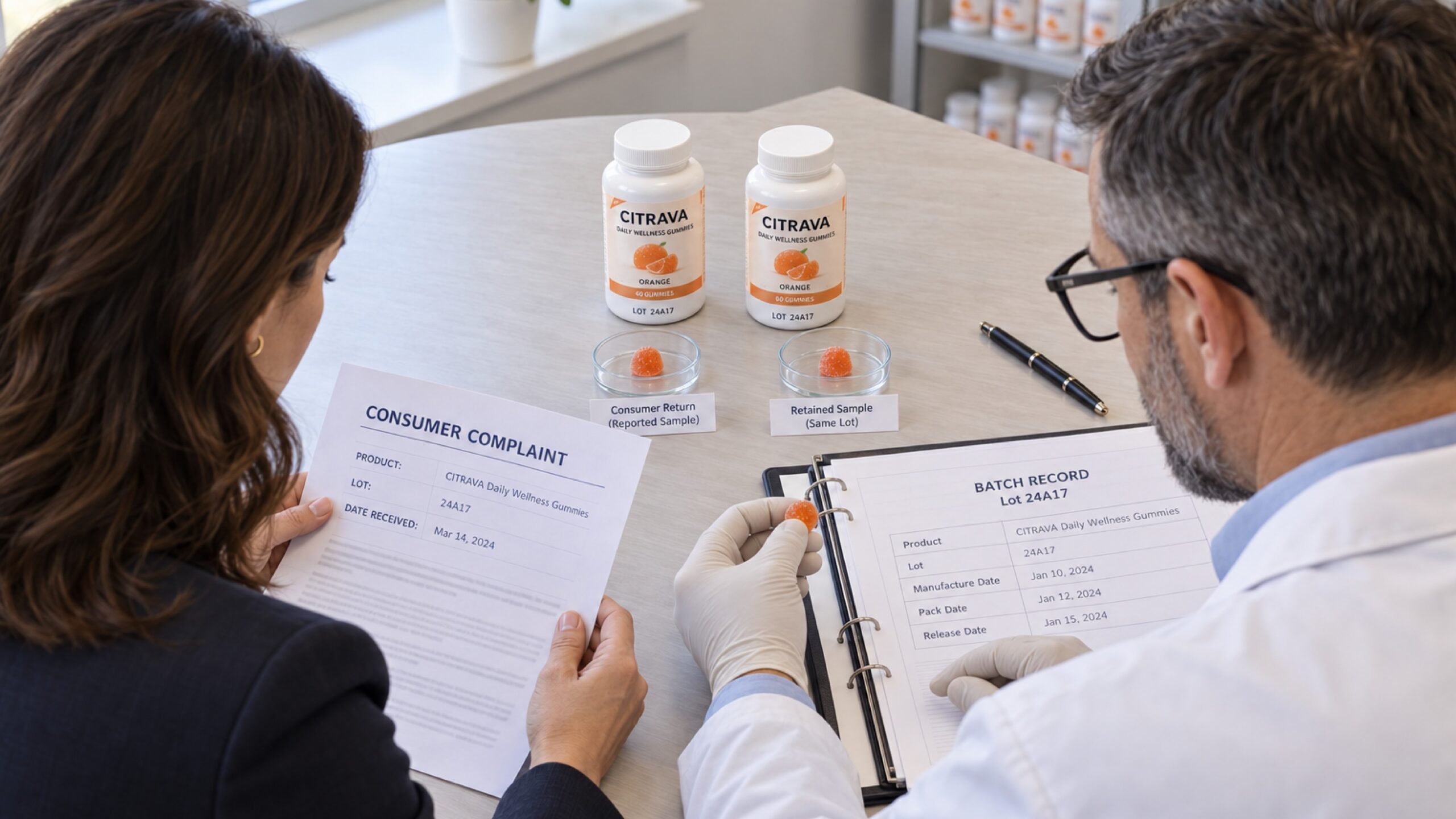
Records and retention samples preserve that history after release. They give the manufacturer a way to investigate a later complaint, compare the product with its original condition, or answer questions about how a particular batch was made.
Prospective clients are unlikely to see every internal procedure, and manufacturers have legitimate reasons to protect confidential systems. Without disclosing those details, a credible manufacturer can explain the product’s path in practical terms, including supplier approval, material receipt, batch traceability, record review, and final release authority.
Clear answers show that quality is built through a sequence of connected controls. Vague assurances make it difficult to know whether the same discipline exists beyond the sales conversation.
Testing Should Answer Questions About the Actual Product
“Tested” is one of the most common claims in supplement manufacturing, but the word says very little on its own. A useful evaluation goes further: What was tested, at which stage, against which requirements, and who reviewed the results?
Testing can serve different purposes throughout production. Incoming ingredient testing helps confirm that a material is what the supplier says it is. Checks performed during manufacturing may help verify that the process is operating as intended. Finished-product testing provides evidence about the completed batch before it is released.
The appropriate testing plan depends on the product. A basic capsule has different considerations from a flavored powder containing multiple active ingredients or a supplement with ingredients that require special handling. Ask the manufacturer to explain how the product’s formula, format, claims, and risks shaped the plan.
This is where a certificate of analysis, or COA, becomes useful. A COA generally identifies the material or product, the specific lot, the tests performed, the applicable specifications, and the reported results. It creates a concise record of what was evaluated and whether the tested sample met the established requirements.
The COA still needs context. An ingredient supplier’s COA describes a particular ingredient lot. It does not automatically establish that the finished product meets every relevant requirement after ingredients have been blended, encapsulated, flavored, or packaged. Buyers should ask which results come from ingredient documentation, which tests the manufacturer performs or verifies, and what evidence supports the release of the finished batch.
The testing method also matters. A result is meaningful when the method is appropriate for the ingredient or product and the acceptance criteria were established before the sample was evaluated. Confirm who performs the test, whether an internal or outside laboratory is used, and who is responsible for reviewing the result.
A capable manufacturer may not disclose every technical detail during an initial sales conversation. It should still be able to describe its reasoning in understandable terms. If the explanation begins and ends with “everything is tested,” the buyer has learned very little. A stronger answer connects the product’s requirements to the samples taken, the tests performed, the records generated, and the final release decision.

Problems Reveal How the Quality System Actually Works
Every manufacturer encounters problems. An ingredient may arrive damaged, a test result may fall outside an established specification, packaging may contain an error, or production may take longer than planned. The quality of the operation becomes visible in how the manufacturer responds.
A well-controlled response begins with containment. Questionable materials or products should be placed on hold so they cannot move forward while the issue is reviewed. The manufacturer then needs to determine what happened, document the investigation, assess the potential effect on the product, and decide what should happen next.
Those decisions require clear authority. A production schedule or shipping commitment should not override a legitimate quality concern. Buyers should ask who can place a material or batch on hold, who investigates the issue, and who has final authority to approve or reject the product.
“Changes and adjustments are part of manufacturing. Good systems surface issues early, assign a decision owner, and give the client time to act before a production problem becomes an inventory problem.” — Steven Anderson, Founder and CEO of Next Day Nutra
Consider an ingredient that produces an unexpected test result. Repeating the test may be appropriate in some circumstances, but it should follow an established process rather than serve as a search for a passing number. An appropriate investigation examines the laboratory work, the sample, the material, and any related production records before reaching a documented conclusion.
Changes deserve similar scrutiny. If an ingredient becomes unavailable, the manufacturer should not quietly substitute another material simply because it has the same name. Differences in source, composition, processing, or documentation may affect the formula and the finished product. The proposed change should be reviewed, recorded, and communicated to the client when it affects the agreed product requirements.
A sales team can describe quality in polished language. A manufacturer’s process for handling failures, deviations, and changes provides stronger evidence. It shows whether the organization can protect the product when the original plan no longer applies.
Communication Is Part of Manufacturing Quality
A manufacturer can handle an issue correctly inside the facility and still create serious problems for the client if communication is late, unclear, or incomplete.
A delayed ingredient, unexpected test result, packaging discrepancy, or production change can affect far more than the batch itself. The client may have advertising scheduled, inventory running low, retail commitments approaching, or multiple locations preparing for a coordinated launch. A medical group may also need to manage availability across practitioners and patients.
Early communication gives the client time to respond. It may be able to adjust a promotion, move inventory, notify internal teams, or change a launch sequence. When an update arrives just before the expected shipping date, many of those options disappear.
During the evaluation, ask how the manufacturer communicates events that could affect the product or timeline. Look for a clear point of contact, defined responsibility for updates, and a path for escalating urgent concerns. Changes to ingredients, specifications, packaging, testing, or delivery expectations should also be documented so both parties are working from the same information.
The quality of those updates matters. “The batch is delayed” leaves the client guessing. A useful update explains what occurred, what is being reviewed, which decisions remain open, when more information is expected, and how the current schedule may be affected. It should distinguish between a confirmed outcome and an early estimate.
Communication during the sales process can offer an early indication of how the relationship will operate. Pay attention to whether answers are direct, follow-up commitments are met, and technical questions reach someone qualified to answer them. Notice whether timelines account for testing and quality review or appear designed only to win the order.
Responsive service supports the quality system by giving the client enough information to make decisions while those controls are being applied. The manufacturer is managing the batch, while the brand is managing everything that depends on it.
Choose a Manufacturer Whose System Fits Your Product
A manufacturer can have a credible quality system and still be the wrong partner for a particular product. The right fit depends on what you are making, how much support your team needs, and how the product will reach customers.
Start with the dosage format and formula. A facility that performs well with straightforward capsules may have less experience with complex flavored powders, difficult ingredients, specialty packaging, or products that require unusual processing. Relevant experience can help the manufacturer anticipate issues before they affect production.
Batch size and growth plans also shape the decision. A new business may need manageable opening quantities, while a scaling operator needs confidence that the manufacturer can support larger orders without disrupting consistency or lead times. Multi-location businesses and medical groups may have additional requirements for inventory coordination, documentation, or distribution.
The working relationship should fit the client’s internal capabilities as well. A company with an experienced product and quality team may be comfortable managing technical decisions directly. A first-time founder may need more guidance with specifications, testing expectations, packaging, and production planning. Buyers should determine who will answer those questions after the sale and how responsibilities will be divided.
Before committing, ask the manufacturer to explain:
- How would this specific product move through your quality system?
- How will its ingredient and finished-product requirements be established?
- What testing will occur, and at which stages?
- Who has the authority to place materials or finished batches on hold?
- How will substitutions, deviations, testing issues, and delays be communicated?
- Which records and quality documents will accompany or remain available for each batch?
The value lies in the substance of the answers. A credible manufacturer should be able to connect its capabilities to the proposed product, clarify what it will handle, identify what the client must approve or provide, and explain where outside laboratories or suppliers are involved.
Without accessing every confidential procedure, buyers can still expect enough visibility to understand how the manufacturer sources materials, controls production, evaluates results, releases batches, preserves records, and communicates decisions. That understanding makes it possible to compare potential partners on the systems that will shape the finished product.
Evaluate the System Before You Commit
Choosing a supplement manufacturer involves comparing prices, timelines, and capability lists. The more consequential question is how the manufacturer’s quality system will protect your specific product. Ask the team to explain how materials are approved, production is documented, testing supports release, and problems or changes are handled.
A useful evaluation leaves you with a clear understanding of who owns key decisions, what evidence will be available, and how the manufacturer will respond when plans change. A COA contributes to that evidence, while the controls surrounding it reveal how the operation protects the finished product.
The right time to establish that confidence is before your formula, capital, and launch schedule depend on the answer.
Next Day Nutra provides supplement brands with reliable manufacturing execution, documented quality controls, production visibility, and direct communication throughout the process. If you are evaluating a manufacturing partner for a new product or your next stage of growth, Schedule a Consultation to discuss your product and production requirements.
Industries
Recent Posts