Industry Insights by The Experts
Industry Intelligence from the Disruptors Redefining Private Label Manufacturing
The 7 Invisible Risks That Kill Private Label Products Before They Launch
Industry: Multi Location, Creators, Scaling Operators
Private label is one of the fastest growing strategies in wellness, but the path from idea to launch is increasingly complex. Most founders come in excited about their formula or brand concept but are unprepared for the operational rigor required to bring a successful product to market.
The result:
Great ideas die quietly inside manufacturing bottlenecks, compliance errors, and last minute fixes that could have been prevented with the right structure.
McKinsey highlights why this foundation matters:
“To keep pace in an expanding global marketplace, businesses are under increasingly intense pressure to develop and launch new products at ever greater speeds.”
Source: McKinsey, A capabilities strategy for successful product development
Brands that understand the hidden risks behind product development outperform the market. Brands that ignore them lose time, money, and trust.
Below are the seven biggest invisible risks that stop private label products before they ever reach customers.
1. Misalignment Between Brand Vision and Formula
Most product failures begin here.
Founders often come in with a general idea like “I want a greens powder” or “I want a preworkout,” but have not defined the strategic purpose of the formula.
When the product’s purpose is unclear:
- Formulation becomes a guessing game
- Ingredient choices conflict with cost targets
- Flavor goals contradict the actives selected
- Claims cannot be supported
- Packaging and dose size fall out of alignment
Why this matters:
Misalignment multiplies downstream. If the formula does not match the brand’s identity or customer promise, every other step becomes increasingly difficult and more expensive to correct.
What high performing brands do instead:
- Define the customer need first
- Identify the core benefit and supporting benefits
- Confirm regulatory constraints early
- Align cost structure with intended retail price
- Make formulation decisions that match marketing strategy
Most founders skip this step because it feels like “planning instead of doing.”
But it is the step that prevents months of rework.
2. Packaging Decisions Made Too Late
Packaging is not art.
Packaging is regulation, engineering, compliance, print science, and workflow management.
Most brands only see the surface layer. They forget that packaging must:
- Match the exact bottle or pouch dimensions
- Work with the selected closure or liner
- Include accurate supplement facts
- Meet FDA formatting requirements
- Follow FTC rules on claims and language
- Include compliant warnings and statement placement
- Pass printer and production checks
As Brittani Kellogg, Director of Quality Control, explains:
"Brands often underestimate how strict FDA and FTC guidelines are. Every claim, statement, panel, and layout needs to be reviewed by someone who truly understands compliance. Catching issues early prevents redesigns that cost weeks of lost time."
The danger:
Packaging errors are one of the top three reasons launch timelines slip.
And they usually show up late, when marketing has already begun.
What high-performing brands do:
- Bring QC and compliance in before design starts
- Approve dielines before creative work
- Validate claims language early
- Ensure formulas and labels match precisely
- Verify that the design is production ready
Packaging is a cross functional process, and most delays come from treating it as a design project instead of an operational component.

3. Unrealistic Development Timelines
Many founders assume a product launch is a linear, sprint-like process.
In reality, it is a coordinated sequence of dependencies.
A delay in one step (like artwork approval) can delay four downstream steps (manufacturing scheduling, label printing, QC checks, fulfillment preparation).
Common timeline misconceptions:
- Believing formulation takes days instead of weeks
- Expecting multiple flavor revisions with no added time
- Assuming packaging can be designed without confirmed compliance
- Forgetting that raw material availability affects batching schedules
- Not realizing that printers, labs, and suppliers have lead times
- Running marketing campaigns before production is locked
Why this matters:
Timelines collapse when expectations and operations do not match.
High growth brands succeed by:
- Planning backwards from their launch date
- Allowing buffer time for QC, artwork changes, and testing
- Confirming ingredient availability early
- Getting full visibility into production schedules
The brands that move fastest are the ones that respect the process, not the ones who try to shortcut it.
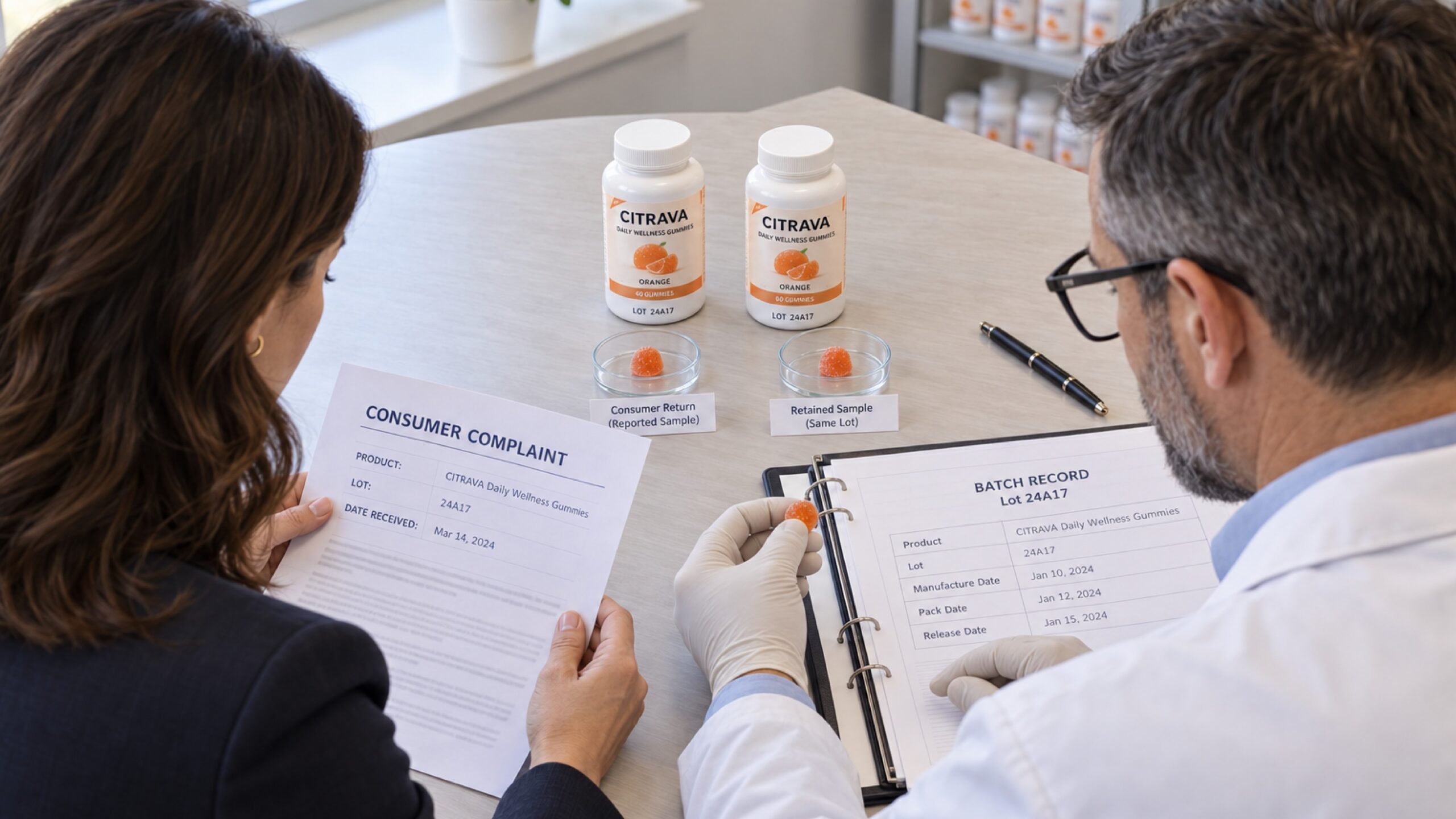
4. Overlooking Quality Control Requirements
QC is not the final step.
It is an embedded process that runs from formulation to fulfillment.
When brands do not integrate QC early, they encounter:
- Failed micro tests
- Incorrect active ingredient levels
- Inaccurate statements of identity
- Non compliant labels
- Carton or bottle failures
- Batch release delays that push launch dates
Why this matters:
Every QC issue discovered late multiplies cost and time by a factor of three to five.
What professional brands do:
- Build QC checkpoints into the lifecycle
- Test ingredients for identity and potency
- Validate labels before printing
- Confirm that packaging matches specifications
- Ensure all documentation is complete before batching
When QC is involved early, brands reduce risk, improve consistency, and protect their credibility.
5. Disconnect Between Manufacturing and Packaging
This is one of the most misunderstood operational risks.
Manufacturing and packaging cannot operate independently. They must align in:
- Bottle size and fill volume
- Label dimensions and placement
- Machinery compatibility
- Component lead times
- Carton and safety requirements
- Pallet configuration and storage constraints
Why it matters:
A mismatch between component and production can halt an entire batching run.
The true cost of misalignment often includes:
- Paying for new labels or containers
- Reprinting delayed packaging
- Lost production slots
- Wasted ingredients
- Extended storage fees
- Rescheduled freight
Brands that treat packaging and manufacturing as two separate conversations often experience the longest and most expensive delays.
6. Late-Stage Changes That Trigger Cost and Delay Cascades
Late stage changes might be the single most expensive mistake a brand can make.
Examples include:
- Switching sweeteners or flavors
- Changing bottle sizes
- Updating claims
- Adjusting serving size
- Adding or removing allergens
- Revising the brand aesthetic
- Swapping active ingredients
Why this destroys timelines:
Every late change restarts multiple workflows:
- New formulation
- New supplement facts panel
- New claim review
- New artwork
- New packaging procurement
- New QC review
- New production slot
A founder’s small preference shift can become a six week reset.
Operationally mature brands:
- Lock decisions early
- Confirm all specs before design
- Avoid aesthetic changes midstream
- Treat compliance as the gatekeeper for claims
- Understand how small updates ripple across systems
Founders often learn this the hard way.
7. No System Connecting All Stages of the Product Lifecycle
This is the largest and most damaging risk.
Most delays happen not because teams fail, but because teams operate in isolation.
Breakdowns show up as:
- Packaging created before formula finalization
- QC checking labels after printing
- Manufacturing waiting on artwork
- Designers unaware of ingredient changes
- Fulfillment preparing for dates that shift by weeks
- Marketing promoting launches before production is confirmed
As Tiffany Chang, Director of Strategic Operations, explains:
"The strongest brands treat product creation as a connected system. When every stage informs the next, launches become smoother and more scalable."
When systems do not communicate, errors multiply.
When they do communicate, brands scale confidently.
Ready to Launch With Confidence?
Most private label failures do not come from bad ideas. They come from weak systems, rushed decisions, and partners who treat product development as a checklist instead of an integrated lifecycle.
Next Day Nutra was built to eliminate these exact risks.
Our teams connect formulation, compliance, design, manufacturing, QC, and fulfillment into one coordinated structure. That integration is what allows brands to:
- Move faster without sacrificing accuracy
- Avoid costly late stage changes
- Launch products with predictable timelines
- Maintain quality across every batch
- Scale their product line without hitting operational ceilings
If you want a partner who manages the complexity for you and gives you a predictable path from idea to shelf:
We will walk through your product vision, identify risks early, and create a clear, actionable roadmap to launch.
Industries
Recent Posts