Industry Insights by The Experts
Industry Intelligence from the Disruptors Redefining Private Label Manufacturing
Proprietary Blends vs. Transparent Labels: What Supplement Brands Need to Consider
Industry: Creators, Scaling Operators, Multi-Location, Medical Groups
Why Supplement Brands Choose Proprietary Blends
Developing a supplement formula takes time, research, and investment. Brands may spend months selecting ingredients, testing combinations, and refining dosages before arriving at a product they’re ready to bring to market. Once that product launches, competitors can examine its label and potentially use that information to develop similar formulas.
This is one reason supplement brands use proprietary blends.
A proprietary blend allows a company to group multiple ingredients together and disclose their combined weight without revealing the exact amount of each ingredient. Under FDA labeling requirements, dietary ingredients in a proprietary blend that do not have established Daily Values must be listed in descending order by weight. The total weight of the blend must be disclosed, but the individual amounts of those ingredients do not have to be listed.
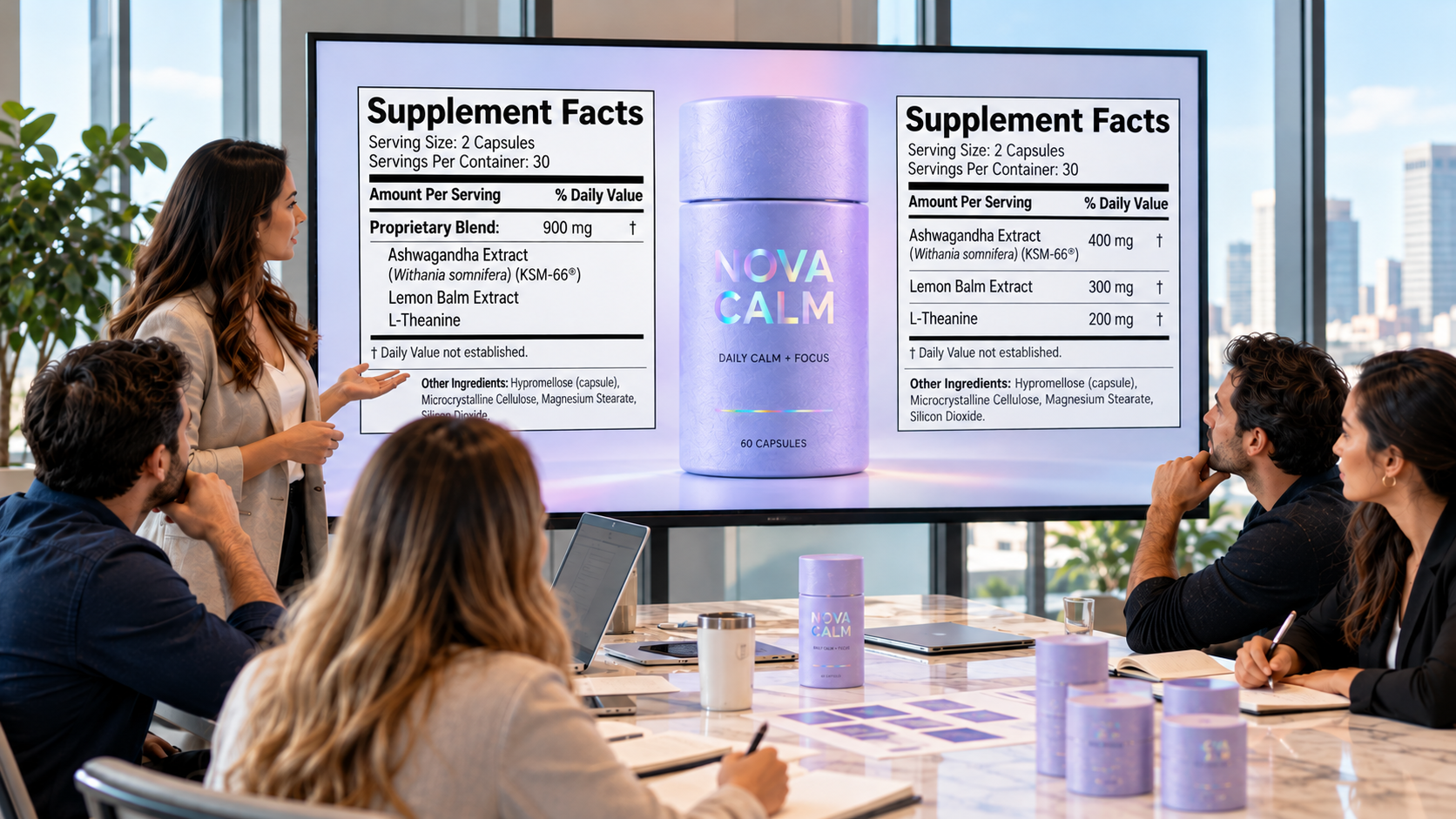
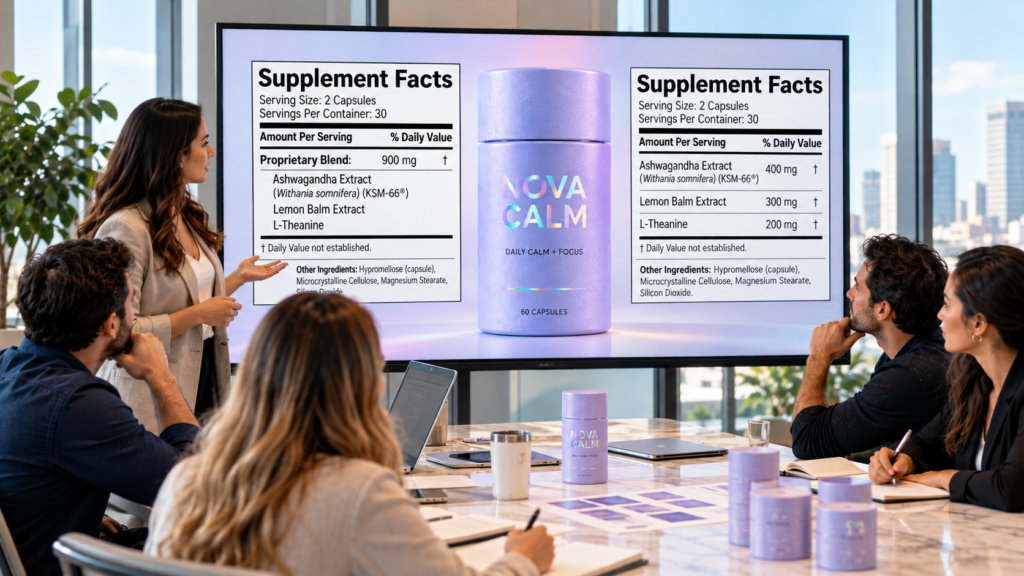
For example, a supplement containing L-theanine, ashwagandha extract, and lemon balm extract might list all three ingredients under a 900 mg proprietary blend. Consumers can see what’s included, but they cannot determine how much of each ingredient they’re getting from the label alone.
For brands that have invested in developing a distinctive formula, limiting that information can offer a competitive advantage. However, consumers may recognize an ingredient and understand its potential benefits without knowing whether the product contains an amount comparable to what has been studied.
A brand may have legitimate reasons to protect its formula, while customers may have equally legitimate reasons to want more information before purchasing it.
What Consumers Can and Cannot Learn From a Supplement Label
When comparing supplements, consumers often look beyond the product’s advertised benefits to see which ingredients are included and how much of each ingredient they’re getting. This information can help them compare products, evaluate dosages, and determine whether a formula aligns with their needs.
Transparent labels make that comparison easier by disclosing individual ingredient amounts. A consumer comparing two L-theanine supplements, for example, can see whether each product provides 100 mg or 200 mg per serving. They can then compare those amounts with published research or other products they’re considering.
With a proprietary blend, consumers can identify the ingredients and their order by weight, but they cannot see the individual amounts. This makes it harder to compare dosages across products or determine whether a particular ingredient is included at an amount comparable to what has been studied.
Disclosing ingredient amounts does not automatically make a supplement more effective or better formulated. A transparent label gives consumers more information to evaluate, but dosage alone cannot establish a product’s quality or effectiveness.
When a product is built around recognizable ingredients, disclosing their dosages helps customers evaluate whether the formula meets their expectations. That information becomes especially useful when comparing similar products in a crowded category.
How Ingredient Transparency Supports Supplement Brand Positioning
For some supplement brands, label transparency is a central part of how they market their products. Alongside claims about energy, sleep, or recovery, they highlight what’s inside the formula, how much of each ingredient it contains, and why those ingredients were selected.
This approach can be particularly useful in competitive categories where products contain many of the same recognizable ingredients. A brand selling a sleep supplement with magnesium and L-theanine, for example, may highlight the amount and form of each ingredient to explain how its formula differs from competing products.
Brands emphasizing research-backed formulations can use dosage disclosure to support their marketing. When a company highlights an ingredient studied at a particular amount, customers can check whether the finished product contains a comparable quantity. That comparison provides useful context, although matching a studied dosage does not guarantee the same results.
Disclosing ingredient amounts can also help brands explain what makes their product different. A company charging a premium for its formula can better explain that price when customers understand which ingredients are included, their amounts, and why they were selected. Those details need to reflect genuine formulation decisions. Listing every dosage offers limited value if the ingredients are poorly selected or the amounts are insufficient for the product’s intended purpose.
For brands competing on formulation quality, disclosing ingredient amounts gives them another way to explain their product’s value. The challenge is making sure the formula delivers on the expectations that disclosure creates.
The Competitive Tradeoffs of Disclosing Your Formula
Supplement brands face a different intellectual property landscape than pharmaceutical companies. While certain new drugs may qualify for periods of regulatory exclusivity, dietary supplements do not receive the same automatic protection for newly developed formulas.
As researchers writing in The Journal of Nutrition explain, “Using proprietary blends is one way that companies can use to protect their trade secrets.”
Keeping individual ingredient amounts private can be valuable when a product’s differentiation depends on a specific combination or ratio of ingredients. Without those details on the label, competitors have less information to work with when developing similar formulas.
However, proprietary blend labeling has limits as a competitive safeguard. Competitors can still identify the ingredients, examine their order on the label, and potentially use laboratory analysis or other research to better understand the formulation. A proprietary blend does not prevent another company from developing a similar product, nor does it provide the legal protections associated with a patent. Some supplement formulations may also qualify for patent or other intellectual property protections.
Full ingredient disclosure does not necessarily reveal everything that makes a supplement distinctive. Two products may contain the same ingredients at similar dosages while differing in raw material specifications, ingredient standardization, sourcing, manufacturing processes, or quality controls. These factors can influence the finished product without being fully apparent from its Supplement Facts panel.
The practical question is which formulation details are worth protecting. If a product’s differentiation depends heavily on a specific ingredient ratio, limiting disclosure may serve a useful purpose. If its value comes from ingredient quality, sourcing, or manufacturing standards, revealing individual dosages may pose less of a competitive concern.
A proprietary blend may help protect a specific ingredient ratio, but it cannot protect every aspect of a product. Brands need to understand what competitors can realistically learn from their labels before deciding how much information to withhold.
How Labeling Decisions Affect Product Development and Marketing
The decision to use a proprietary blend or disclose individual ingredient amounts should be made early in product development. It influences how a brand presents its formula, which details it can highlight in marketing, and what information appears on the finished product’s label.
“We've seen how decisions made during formulation can affect everything that comes afterward, from packaging to marketing. Brands need to think about what they want to communicate to customers before they finalize the formula and label.”
Steven Anderson, CEO of Next Day Nutra
Consider a brand that develops a supplement using a proprietary blend but later decides to emphasize specific ingredient dosages in its marketing. The formula may already contain the intended amounts, but the Supplement Facts panel does not disclose them individually. If the brand wants customers to verify those dosages directly on the label, it will need to reconsider its labeling approach.
Changes at this stage can affect more than the Supplement Facts panel. Packaging artwork, product descriptions, website content, and advertising materials may all need to be updated. If labels have already been printed or production is scheduled, these revisions can introduce additional costs and delay a product launch.
The decision also has implications for future product development. A brand building its reputation around fully disclosed formulas may want to carry that approach across its product line. Establishing those expectations early helps product development and marketing teams work toward the same goals as new formulas are introduced.
Addressing labeling strategy before finalizing packaging and production gives brands more flexibility to make informed decisions. It also reduces the risk of discovering late in development that the information a brand wants to communicate does not align with what its product label actually discloses.
Choosing a Labeling Strategy That Fits Your Product and Brand
The right labeling approach depends on what makes a supplement valuable to its intended customers and how the brand plans to compete. A proprietary blend may make sense for a formula built around a distinctive ingredient combination, while full ingredient disclosure may be more useful for products marketed around specific dosages and research-backed ingredients.
Before committing to either approach, brands should consider how customers are likely to evaluate the product. Someone purchasing a supplement based on a particular ingredient may want to compare its dosage with published research or competing formulas. In that situation, individual ingredient disclosure can help answer questions that might otherwise prevent a purchase. For products where the value comes from a broader combination of ingredients, brands may place greater importance on protecting the formulation’s specific ratios.
The decision should also reflect the brand’s long-term positioning. A company building its reputation around ingredient transparency needs formulas that support that promise. A brand choosing proprietary blends should be prepared to explain the reasoning behind its approach and demonstrate product quality through other information, such as ingredient sourcing, testing, and manufacturing standards.
Regardless of the labeling strategy, the underlying formulation still needs to meet the product’s intended purpose. Ingredient selection, dosage, quality, and manufacturing consistency all influence the finished product. The amount of information disclosed on a label does not replace those fundamentals.
Making this decision early allows brands to develop products with a clearer connection between their formulation, packaging, and marketing strategy. It also reduces the likelihood of costly changes after production planning is underway.
For supplement brands evaluating proprietary blends, transparent labels, or a new product formulation, working with an experienced manufacturing partner can help clarify the practical implications before those decisions become difficult to change.
Build a Formula That Supports Your Brand Strategy
Next Day Nutra helps supplement brands turn formulation decisions into production-ready products, with support for ingredient selection, labeling considerations, and manufacturing execution.
Industries
Recent Posts