
Industry Insights by The Experts
Industry Intelligence from the Disruptors Redefining Private Label Manufacturing
The Hidden Economics of Supplement Fulfillment (And Why It Matters More Than You Think)
Industry: Creators, Scaling Operators, Multi-Location
Most supplement brands think fulfillment is simple.
Store inventory. Pack orders. Ship products.
But once a dietary supplement or CPG brand starts growing, fulfillment becomes much more than a shipping function. It affects margins, customer retention, cash flow, inventory accuracy, and the overall customer experience.
And when fulfillment starts breaking down, growth gets harder.
That shift is happening across nearly every industry. According to Gartner research,
“83% of companies now place customer-experience enhancement at the center of their digital business strategy for supply chains.”
— Supply Chain Management Review
For supplement brands, that matters even more because customers are not buying products once. They are building routines around products they expect to receive consistently.
If shipments arrive late, products show up damaged, or subscription orders fail, customers do not blame the warehouse. They blame the brand.
The problem is that many fulfillment costs stay hidden early on.
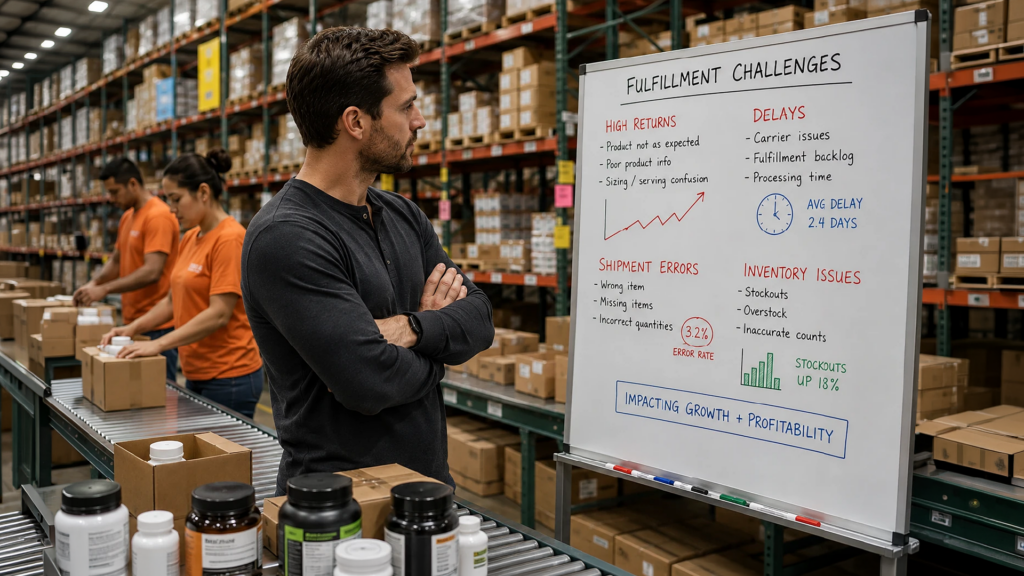
At smaller order volume, inefficiencies feel manageable. A few shipping delays may not seem like a major issue. But once volume increases, those small problems start multiplying fast.
Shipping costs increase. Refund requests grow. Support tickets pile up. Subscription churn rises. Teams spend more time fixing problems instead of growing the business.
Many DTC supplement brands get stuck here. Revenue grows, but friction grows with it.
The brands that scale well understand something many companies learn too late: fulfillment is not just about getting products out the door. It plays a major role in customer experience, retention, and profitability.
Fulfillment Is No Longer a Back-End Function
Ecommerce changed fulfillment permanently.
Amazon raised delivery expectations. Real-time tracking became standard. Subscription models increased pressure on consistency and inventory accuracy.
Customers now expect fast shipping, visibility, and reliability with every order.
That means fulfillment is no longer isolated to warehouse operations. It directly shapes how customers experience a brand.
When fulfillment works well, customers barely notice it. Orders arrive on time. Tracking updates make sense. Products arrive intact. Subscription deliveries stay consistent.
But when fulfillment breaks down, customers notice immediately.
A delayed greens powder shipment interrupts someone’s routine. A damaged protein tub creates frustration before the product is even opened. A missed subscription order can easily turn into a cancellation.
These issues create consequences far beyond shipping costs.
Poor supplement fulfillment increases support tickets, refund requests, negative reviews, and customer churn. It also hurts customer acquisition performance because brands end up replacing customers they should have retained.
This is one of the hidden economics many supplement and CPG brands underestimate. Weak fulfillment systems quietly affect customer lifetime value, retention, and long-term growth.
As brands grow, those weaknesses become harder to manage.
- Manual workflows create bottlenecks.
- Inventory mistakes become more common.
- Shipping inefficiencies become more expensive.
- Teams spend more time reacting and less time improving the business.
The strongest fulfillment systems create the opposite effect. They reduce friction, improve retention, and help brands scale with more consistency.
The Hidden Costs Most Supplement Brands Miss
Most fulfillment problems do not show up clearly on a P&L.
Instead, they appear through shrinking margins, customer churn, shipping inefficiencies, and internal chaos. That is why many supplement brands underestimate how expensive weak fulfillment systems become over time.
Shipping Inefficiencies Add Up Fast
Shipping is one of the biggest hidden costs in ecommerce fulfillment.
Many supplement brands focus heavily on manufacturing costs and customer acquisition while overlooking packaging inefficiencies, dimensional weight pricing, split shipments, and carrier strategy.
A few extra dollars per shipment may not seem important at first. But at scale, those costs add up quickly.
Poor packaging can increase dimensional weight charges across thousands of orders. Inventory spread across multiple warehouses can create unnecessary split shipments. Weak carrier agreements can slowly eat into margins month after month.
“Most fulfillment problems do not look expensive at first. It is usually death by a thousand cuts. A few extra dollars in shipping here, a small inventory issue there, delayed subscription orders during a promo. Over time, those problems start stacking on top of each other." — Logan Anderson, Fulfillment Operations Manager, Next Day Nutra
On the surface, the fulfillment operation may seem fine, but as you scale, margins start getting tighter.
Inventory Problems Create Cash Flow Problems
Inventory problems create pressure fast.
Too much inventory ties up cash and increases storage costs. Too little inventory creates stockouts, delayed shipments, and subscription interruptions.
For dietary supplement brands, forecasting becomes even more important because demand often changes around launches, promotions, influencer campaigns, and recurring subscription orders.
Without strong inventory visibility, brands end up making reactive decisions.
A sudden influencer spike or successful product launch can create inventory problems fast if forecasting is weak. Overselling products creates delayed shipments, frustrated customers, and support issues that ripple across the business.
That usually leads to:
- emergency production runs
- rushed freight costs
- delayed customer orders
- inaccurate forecasting
- internal confusion between teams
At scale, inventory management becomes much more than storage. It becomes a core part of running the business efficiently.
Customer Experience Problems Become Expensive
Customers expect supplement fulfillment to feel seamless.
When orders arrive late, damaged, incorrect, or poorly packaged, the impact goes far beyond a single order.
Poor fulfillment performance increases:
- support tickets
- refund requests
- chargebacks
- subscription cancellations
- negative reviews
- customer distrust
This matters even more for supplement brands because repeat purchases drive long-term profitability.
A customer who loses confidence in delivery consistency is far less likely to remain subscribed or reorder consistently.
Many brands spend heavily on customer acquisition while underestimating how fulfillment problems hurt retention on the backend.
That imbalance becomes expensive quickly.
Internal Friction Slows Growth
One of the most overlooked fulfillment costs is internal friction.
Many growing supplement brands rely on disconnected spreadsheets, manual workflows, and reactive communication longer than they should.
At lower volume, those inefficiencies stay hidden.
At scale, they become bottlenecks.
Teams spend more time solving avoidable problems. Customer service gets overloaded. Inventory reconciliation becomes harder. Small fulfillment mistakes create larger downstream issues.
This is usually the point where brands realize the warehouse is no longer the only issue.
The companies that scale well are usually the ones that build structure before growth pressure forces them to.
Compliance and Risk Management Add Another Layer of Complexity
Supplement fulfillment is more complex than standard ecommerce fulfillment.
Dietary supplement fulfillment requires tighter inventory controls, expiration monitoring, lot traceability, recall readiness, and stronger consistency across warehouse operations.
As brands grow, those requirements become harder to manage without the right systems in place.
This is where risk starts increasing quietly in the background.
If inventory tracking becomes inconsistent, brands can run into fulfillment errors, expired product issues, inventory discrepancies, or recall management problems. Weak warehouse organization also increases the chances of preventable mistakes that hurt customer trust.
For subscription-based supplement brands, the stakes become even higher. Customers expect consistency with products they use daily. Inventory disruptions or fulfillment failures can quickly affect retention and recurring revenue.
That is one reason many supplement brands outgrow generic 3PL providers. Nutraceutical fulfillment requires more than simply moving packages through a warehouse. It requires systems built around visibility, accuracy, and consistency.
The brands that scale successfully are usually the ones treating fulfillment as part of long-term business strategy, not just logistics.
Why Fulfillment Problems Compound as Brands Scale
Small fulfillment problems get expensive fast as brands grow.
A process that feels manageable at 50 orders per day can become a serious problem at 5,000 orders per day. Small gaps in communication, inventory management, shipping workflows, or reporting start compounding across the business.
Many supplement brands start feeling unexpected pressure on margins during this stage of growth.
Customer acquisition increases order volume, but the fulfillment infrastructure does not always scale at the same pace. Teams become reactive. Forecasting gets harder. Shipping inconsistencies increase. Customer support volume rises.
Subscription orders may ship late during promotional spikes. Inventory counts stop matching in real time. Customer service teams spend more time resolving preventable problems.
Eventually, growth starts creating friction instead of momentum.
Subscription-based supplement brands are especially vulnerable because recurring revenue depends heavily on consistency and trust.
When fulfillment performance becomes unreliable:
- retention drops
- lifetime value decreases
- acquisition costs become harder to recover
- profitability gets squeezed
At the same time, leadership teams become trapped in constant firefighting.
Instead of focusing on growth strategy, teams spend time solving shipment delays, inventory problems, order corrections, and customer complaints.
As complexity increases, weak systems become impossible to ignore.
That is why scalable fulfillment systems matter so much for growing supplement brands.
The brands that scale efficiently are usually not the ones moving the fastest early on. They are the ones building systems capable of supporting growth without falling apart under pressure.
The Best Fulfillment Operations Create Strategic Advantage
Strong fulfillment operations do more than reduce shipping problems.
They make the entire business run better.
When fulfillment systems are efficient, brands gain better inventory visibility, stronger forecasting, faster decision-making, and more predictable customer experiences.
That stability affects nearly every part of the business.
Reliable fulfillment builds customer trust. Better inventory visibility improves forecasting and cash flow planning. Efficient shipping reduces friction across the customer experience.
Over time, consistency becomes a competitive advantage.
This is especially important for supplement and CPG brands operating in crowded ecommerce markets. Products alone are rarely enough to create long-term differentiation. Execution quality matters.
The strongest supplement fulfillment partners understand this.
They are not simply processing outbound orders. They help brands reduce friction, improve retention, support subscription consistency, and scale more efficiently.
That is very different from transactional fulfillment.
For growing wellness brands, fulfillment should not be viewed as a necessary expense.
It should be viewed as growth infrastructure.
What Supplement Brands Should Look for in a Fulfillment Partner
Not all fulfillment providers are built for dietary supplement fulfillment.
Many ecommerce fulfillment companies can handle basic shipping operations, but supplement fulfillment introduces added complexity around inventory management, subscription consistency, lot traceability, packaging requirements, and scalability.
As brands grow, those differences matter more.
One of the biggest mistakes supplement companies make is choosing fulfillment partners based mainly on price. Lower fees may look attractive upfront, but inefficiencies often create larger downstream costs through shipping problems, inventory issues, customer churn, and internal strain.
The better approach is evaluating supplement fulfillment services based on long-term performance.
Here are a few areas growing supplement brands should prioritize:
Supplement and CPG Experience
Dietary supplements require a different operational standard than many traditional ecommerce products.
Your fulfillment partner should understand recurring purchasing behavior, inventory rotation, packaging consistency, lot traceability, and the demands involved in scaling wellness brands.
Operational Visibility
Brands should have clear visibility into inventory levels, order status, shipment tracking, and reporting.
Limited visibility creates reactive decision-making. Strong systems create control.
Scalability
Many fulfillment operations work well at low volume but struggle once brands begin scaling aggressively.
A fulfillment partner should be capable of supporting higher order volume, SKU expansion, promotional spikes, subscription growth, and multichannel operations without creating instability.
Shipping Optimization
Shipping costs directly affect profitability, especially as order volume increases.
Strong fulfillment partners actively optimize packaging configuration, carrier strategy, warehouse workflow, and shipping efficiency instead of simply processing orders.
Communication and Responsiveness
Operational issues become much harder to solve when communication is delayed or fragmented.
Strong fulfillment relationships depend on visibility, responsiveness, and proactive coordination. Brands should not feel disconnected from the team managing a major part of their customer experience.
Systems and Integration
Disconnected systems create unnecessary friction.
Modern supplement fulfillment operations should integrate cleanly with ecommerce platforms, inventory systems, subscription tools, and reporting software to reduce manual work and improve efficiency.
Ultimately, the right fulfillment partner should simplify operations, improve scalability, and reduce friction as the business grows.
At that point, fulfillment affects nearly every part of the business.
Fulfillment Is a Profitability Decision, Not Just a Logistics Decision
Many supplement brands still treat fulfillment like a backend cost center.
The reality is much bigger than that.
Fulfillment affects customer retention, cash flow visibility, shipping costs, subscription performance, and long-term profitability. It directly affects how efficiently brands can grow without creating chaos behind the scenes.
That is why fulfillment decisions have direct financial consequences.
The cheapest option is not always the smartest long-term financial decision. Weak systems, shipping inefficiencies, inconsistent processes, and poor visibility create hidden costs that become more expensive as brands scale.
The strongest dietary supplement and CPG brands understand this early.
They invest in systems before inefficiencies become major constraints. They prioritize fulfillment partners that improve visibility, reliability, and scalability. And they recognize that customer experience does not stop after checkout.
It continues through delivery, consistency, and reliability.
In today’s ecommerce environment, fulfillment is no longer just logistics.
It is part of retention strategy, customer experience, and long-term growth.
For supplement brands looking to scale efficiently, fulfillment is not just about shipping products faster.
It is about building systems that support sustainable growth.
Conclusion
As supplement and CPG brands grow, complexity grows with them.
What works at low order volume often starts breaking under scale. Shipping inefficiencies become more expensive. Inventory issues become harder to manage. Customer expectations increase. Internal friction starts affecting profitability and retention.
That is why fulfillment matters far more than many brands initially realize.
The strongest companies do not treat fulfillment as a disconnected backend function. They treat it as a core part of customer experience, growth strategy, and long-term scalability.
Because in modern ecommerce, operational efficiency is not just infrastructure.
It is a competitive advantage.
We Can Help
Looking to improve fulfillment performance for your dietary supplement or CPG brand?
Next Day Nutra helps supplement and wellness brands streamline fulfillment operations, improve scalability, and build systems designed for long-term growth.
Book a call with our team to learn how stronger fulfillment infrastructure can support profitability, retention, and scale: https://nextdaynutra.com/book-an-appointment
Industries
Recent Posts